

Key Takeaways (TL;DR)
The Best Overall Lead Intelligence Platform: ZoomInfo remains the strongest enterprise-grade choice, with the deepest B2B contact database and GTM Studio features that keep expanding. It typically requires a one-year contract minimum.
Why Do You Need It?: Reps waste hours on manual research and outreach to contacts who never fit the account in the first place. The right tool puts enrichment, scoring, and outreach data in one place instead of 5 disconnected subscriptions.
Who It's For?: RevOps leaders, founders, and sales teams who need accurate contact and company data to prioritize outreach, whether that is an enterprise team with a dedicated data budget or a seed-stage founder building a first outbound motion.
How to Choose the Right One?: Match the platform to company stage and technical capacity, since an enterprise-grade tool overshoots a 5-person team and a lightweight one underserves a 500-person org. Contract length, setup complexity, and whether your team can actually configure the tool matter as much as the feature list.
Expected Price: Pricing spans a wide range across this category. Clay starts at $167 per month and Apollo at $49 per seat per month, both with free plans available; Cognism starts at $14,000 per year, ZoomInfo around $15,000 per year, and Amplemarket at $600 per month, with all 3 scaling on custom quotes from there.
Table of Contents
Lead Intelligence Platforms at a Glance
What Is a Lead Intelligence Platform?
Why Do You Need A Lead Intelligence Platform?
Who Needs A Lead Intelligence Platform?
Best Platforms: In-Depth Review and Comparison
How to Choose the Best Option (What to Consider)?
Everything You Need to Know About Lead Intelligence Platforms
Where The GTM Engineering Company Fits In Here?
FAQs About Lead Intelligence Platforms
Lead Intelligence Platforms: at a Glance
Tools | Best For | Key Features | Pricing |
ZoomInfo | Enterprise teams needing the deepest B2B contact database | GTM Studio, intent data, org charts, technographics | Custom, from around $15,000 per year |
Clay | Mid-market teams with the technical capacity to build custom workflows | Waterfall enrichment, AI agents, dozens of data provider integrations | Free plan, from $167 per month |
Apollo.io | Early-stage and SMB teams wanting data and outreach in one tool | Contact database, sequencing, dialer, chrome extension | Free plan, from $49 per seat per month |
Cognism | SMB and mid-market teams prioritizing verified phone and mobile data | Diamond data verification, intent signals, sequencing | From $14,000 per year, 5 seats included |
Amplemarket | Teams wanting signals, data, and sequencing consolidated in one platform | AI SDR features, LinkedIn automation, job change alerts, unified inbox | From $600 per month, 2 users included |
What Is a Lead Intelligence Platform?
This category of software combines contact and company data with signals like funding events, job changes, and buying intent, so sales and marketing teams can identify and prioritize the right accounts and people to reach out to.
The category overlaps with sales intelligence platform, GTM platform, and revenue intelligence platform tools, but the core function stays consistent across vendors: find accurate data, layer in signals that indicate readiness to buy, and hand that information to a rep or a workflow before the moment passes.
Most B2B teams already own more of this category than they realize. A CRM, an outbound sequencer, and a data provider all touch lead intelligence in some way.
The platforms in this guide are the ones that own the data & enrichment layer specifically, rather than the CRM or the sending tool sitting on top of it.
Why Do You Need A Lead Intelligence Platform?
Manual prospecting does not scale. A rep researching one account at a time, checking LinkedIn, guessing at a title, and hoping an email address is current, burns hours that should go toward actual selling.
Stale data compounds the problem. Roughly 40 to 60 percent of contacts in a typical CRM have already left the company associated with their record, which means reps are often reaching out to people who cannot say yes even if they wanted to.
The right tool closes that gap in a few concrete ways:
Keeps contact and company data current instead of relying on a one-time import
Layers in signals that separate a warm account from a cold one
Runs the enrichment automatically, so a rep opens their day with a prioritized list instead of a blank search bar
The gap most teams miss is not data volume. It is data that stays accurate and gets used.
Buying a bigger database does not fix a workflow where nobody checks whether a contact still works there.
Who Needs A Lead Intelligence Platform?
The right choice depends heavily on company stage, team size, and how much internal capacity exists to configure and maintain the tool.
Here's a quick look at the key personas who are most likely to search for lead intelligence platforms:
1. Enterprise Sales Organizations
Large sales orgs running account-based motions across hundreds of target accounts need the depth and org-chart mapping that only an enterprise-grade lead intelligence platform provides.
These teams usually have a budget for a longer contract and a dedicated admin to manage the platform, which changes the calculus compared to a smaller team.
2. Mid-Market RevOps Teams
RevOps leaders at mid-market companies need flexibility more than raw scale, since their data needs shift as the company grows and their ICP sharpens.
This segment benefits most from platforms that can be customized without a full engineering team, though the tradeoff is usually a steeper learning curve.
3. SMB and Early-Stage Founders
Seed and pre-seed founders need a single tool that handles data, sequencing, and basic scoring without requiring a specialist to configure it.
Simplicity matters more than depth at this stage, since the founder is often the one running outbound personally.
4. Sales Development Teams
SDR and BDR teams need a platform that surfaces the right accounts fast, without burying them in features that slow down daily prospecting.
Speed to a prioritized list matters more here than the breadth of the underlying database.
5. RevOps and GTM Engineering Practitioners
Teams building custom scoring models, signal-based outbound, or CRM writeback workflows need a platform flexible enough to serve as a data layer rather than a closed system.
This segment often pairs a data provider with a build layer, since off-the-shelf configuration rarely matches what a custom GTM stack actually needs.
Best Platforms: In-Depth Review and Comparison
1. ZoomInfo
Overview
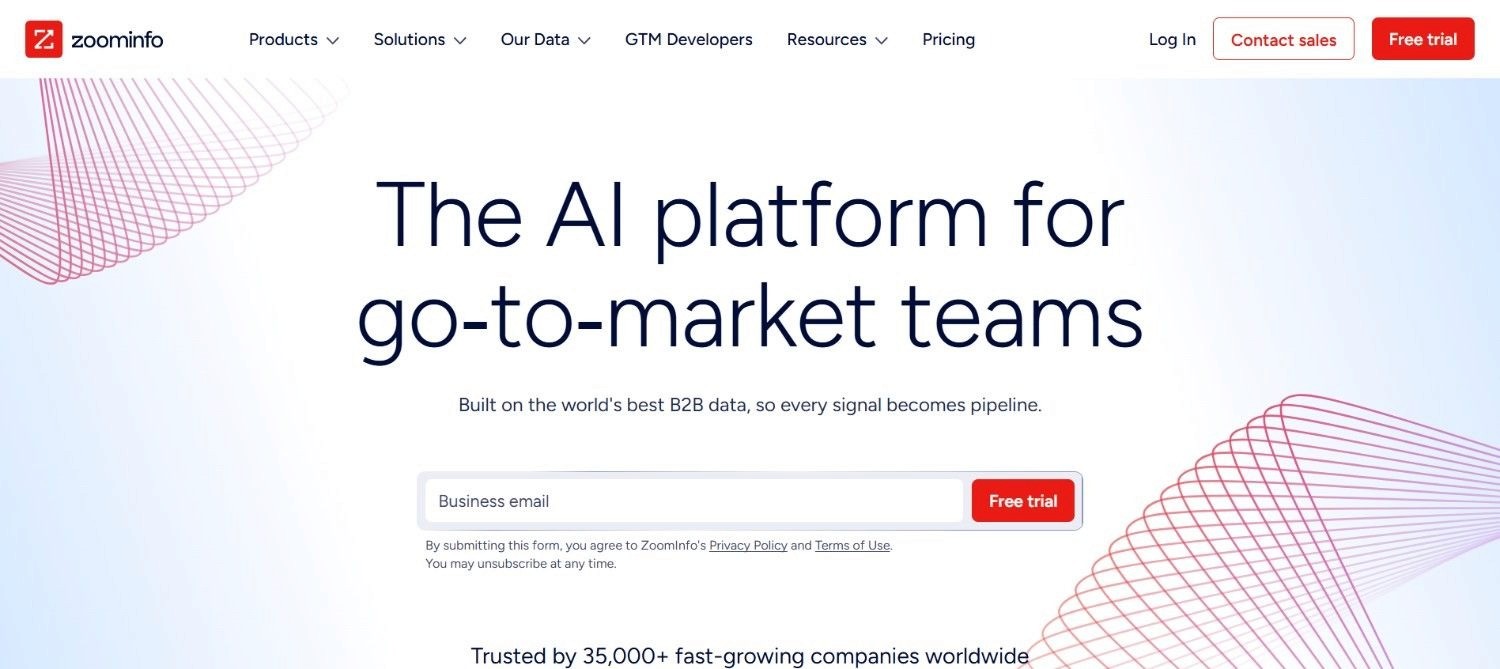
ZoomInfo remains the deepest B2B contact database available, and it consistently comes up first in any conversation about enterprise-grade lead intelligence.
Coverage is the standout factor. Few competitors match the breadth of firmographic, technographic, and org-chart data ZoomInfo maintains across industries and company sizes.
The platform has also expanded beyond a static database. Its GTM Studio features now let teams build workflows on top of the core data, a capability that keeps growing in adoption among enterprise buyers who want more than a lookup tool.
That expansion comes with commitment. ZoomInfo typically requires at least a one-year contract, and sales reps frequently push toward multi-year deals to bring the monthly cost down. Buyers who want flexibility should expect that pressure during negotiation.
Ideal For
Enterprise sales organizations running account-based motions at scale
Teams that need the broadest possible B2B contact coverage
Organizations ready to commit to at least a one-year contract
Top Features
GTM Studio for building workflows on top of core contact and company data
Deep org-chart mapping for navigating complex buying committees
Intent data signals layered across a large B2B dataset
Why They Stand Out?
ZoomInfo's data coverage is difficult for smaller providers to match, since the company has spent years building and maintaining its database at enterprise scale.
The addition of GTM Studio signals a shift from a static contact list toward an active platform, which matters for enterprise buyers who want to build on top of the data rather than just export it.
Pros
Broadest B2B contact and company database in the category
GTM Studio adds workflow capability beyond basic data lookup
Strong technographic and intent data layered on top of contact records
Cons
Requires at least a one-year contract, with sales pressure toward multi-year deals
Pricing scales quickly for larger teams and higher data volumes
Overkill for smaller teams that do not need enterprise-level coverage
Pricing
ZoomInfo uses custom, seat- and credit-based pricing, with entry plans starting around $15,000 per year.
Final Verdict
ZoomInfo fits enterprise teams that need the deepest available B2B contact database and have the budget and contract flexibility to commit long term.
Smaller teams or anyone wary of a locked-in annual commitment should look further down this list.
2. Clay
Overview
Clay approaches lead intelligence differently than a traditional database vendor. Rather than owning one dataset, it lets teams build enrichment and scoring workflows on top of dozens of data providers at once.
That flexibility is the draw. Clay is one of the more adaptable options in this category, particularly for mid-market teams past the SMB stage but not yet ready for enterprise-grade tools.
The tradeoff, though, is real. Getting value out of Clay requires someone who understands the platform deeply: not just how to click through it, but how to design a workflow that holds up.
Because of that, most companies need an internal expert or a build partner to implement it.
On top of that, Clay connects to more integrations than most competitors, part of why it keeps gaining ground in the mid-market segment.
Ideal For
Mid-market teams that are cheaper to serve than enterprise but need more flexibility than SMB tools offer
Companies with an internal Clay expert or a build partner who can implement workflows
Teams that want to build custom scoring and enrichment rather than use a fixed feature set
Top Features
Waterfall enrichment pulling from dozens of data enrichment tools and providers in one workflow
Custom AI agents for research, scoring, and classification tasks
Extensive integration library connecting to CRMs, sequencers, and email enrichment tools teams already run
Why They Stand Out?
Clay's core strength is flexibility. Where most platforms give you a fixed feature set, Clay gives you a building block system, so a team can construct exactly the workflow their GTM motion needs.
That same flexibility explains why Clay usually shows up in a Clay vs Apollo comparison as the more technical, more customizable option of the two.
Pros
Most affordable and flexible option among established lead intelligence software
Broad integration ecosystem not matched by most competitors
Scales from a single workflow to a full enrichment and scoring system
Cons
Requires real technical investment to build a workflow that performs well
Most teams need either an internal expert or outside help to implement it properly
Credit-based pricing can get expensive at high enrichment volume without cost controls
Pricing
Clay offers a free plan, with paid plans starting at $167 per month (Launch) and $446 per month (Growth), while Enterprise pricing is custom. Plans scale based on annual actions and data credits, with higher tiers adding CRM sync, automation, integrations, and dedicated support.
Final Verdict
Clay fits mid-market teams that want more control and lower cost than enterprise tools offer, provided someone on the team can actually build inside it.
Without that technical capacity, though, budget for implementation help instead, or consider a more turnkey lead intelligence software option with less setup overhead.
For a broader set of options in the same category, see our list of the top Clay alternatives.
3. Apollo.io
Overview
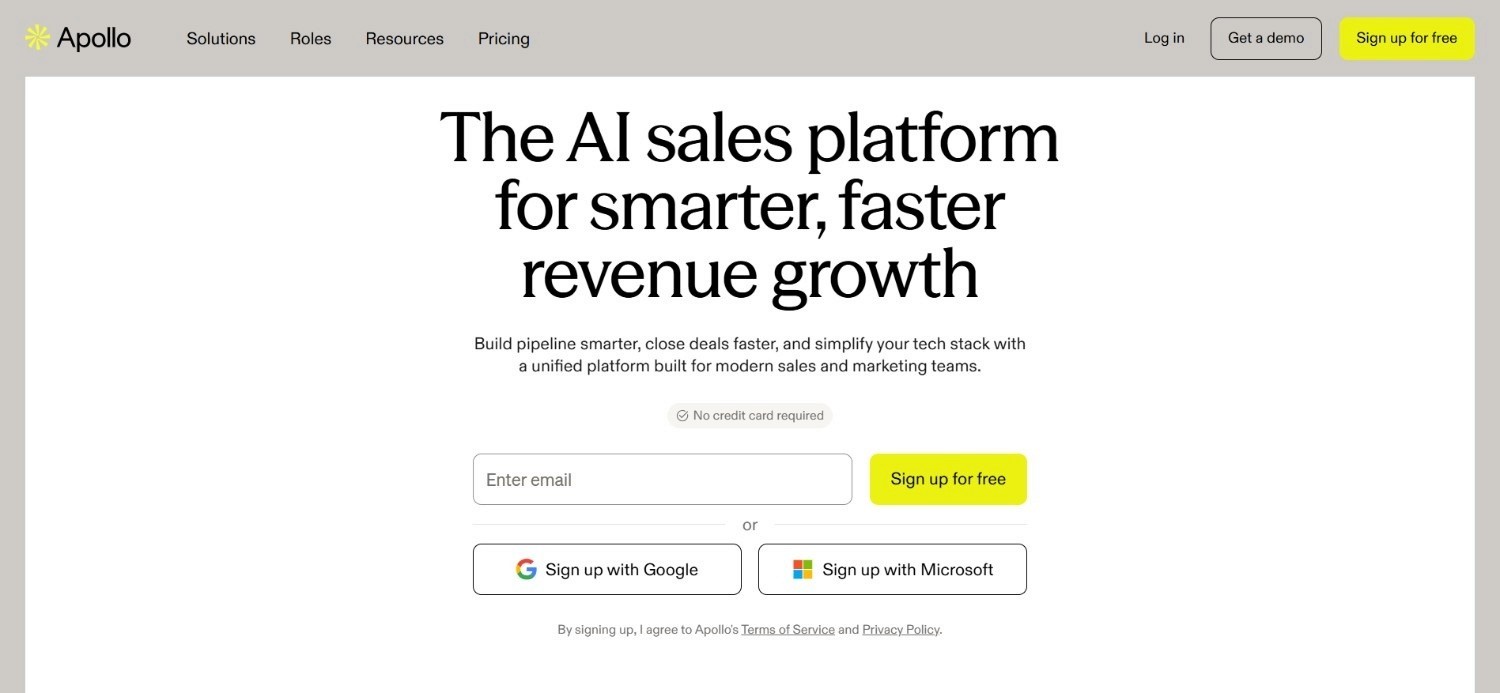
Apollo.io pairs a contact database with sequencing and outreach tools in a single lead intelligence platform, which makes it a common starting point for teams that want everything in one place.
The database itself is solid without matching the depth of an enterprise-grade provider, and that tradeoff is intentional. Apollo is built for teams that need a functional data and outreach tool without the setup complexity or contract length that comes with larger tools.
The platform bundles enrichment, sequencing, and basic scoring, so a small team does not need to stitch together 3 separate subscriptions to run outbound.
Ideal For
SMB teams and pre-seed founders who need one tool covering data and outreach
Teams without a dedicated RevOps function to manage a more complex platform
Companies prioritizing speed to first outbound campaign over data depth
Top Features
Combined contact database and sequencing in one subscription
Built-in dialer and Chrome extension for fast prospecting
Basic scoring and workflow automation without heavy setup
Why They Stand Out?
Apollo's advantage is consolidation at an accessible price point. A founder or small team can get a working outbound motion running without evaluating and buying 3 separate tools.
Pros
Affordable entry point compared to enterprise platforms
Database, sequencing, and basic automation bundled together
Fast to set up for teams without dedicated RevOps support
Cons
Data depth does not match enterprise-grade providers
Feature set can feel limiting once a team's GTM motion matures
Less suited to complex, multi-stage account-based strategies
Pricing
Apollo.io offers a free plan plus paid tiers billed annually: Basic at $49 per seat per month, Professional at $79 per seat per month (most popular), and Organization at $119 per seat per month. Add-ons like extra credits, advanced email domains, and additional integrations are priced separately.
Final Verdict
Apollo.io suits SMB and early-stage teams that need something working fast, without a long contract or a steep learning curve.
Growing teams that outpace its data depth should plan to reevaluate as they scale.
4. Cognism
Overview
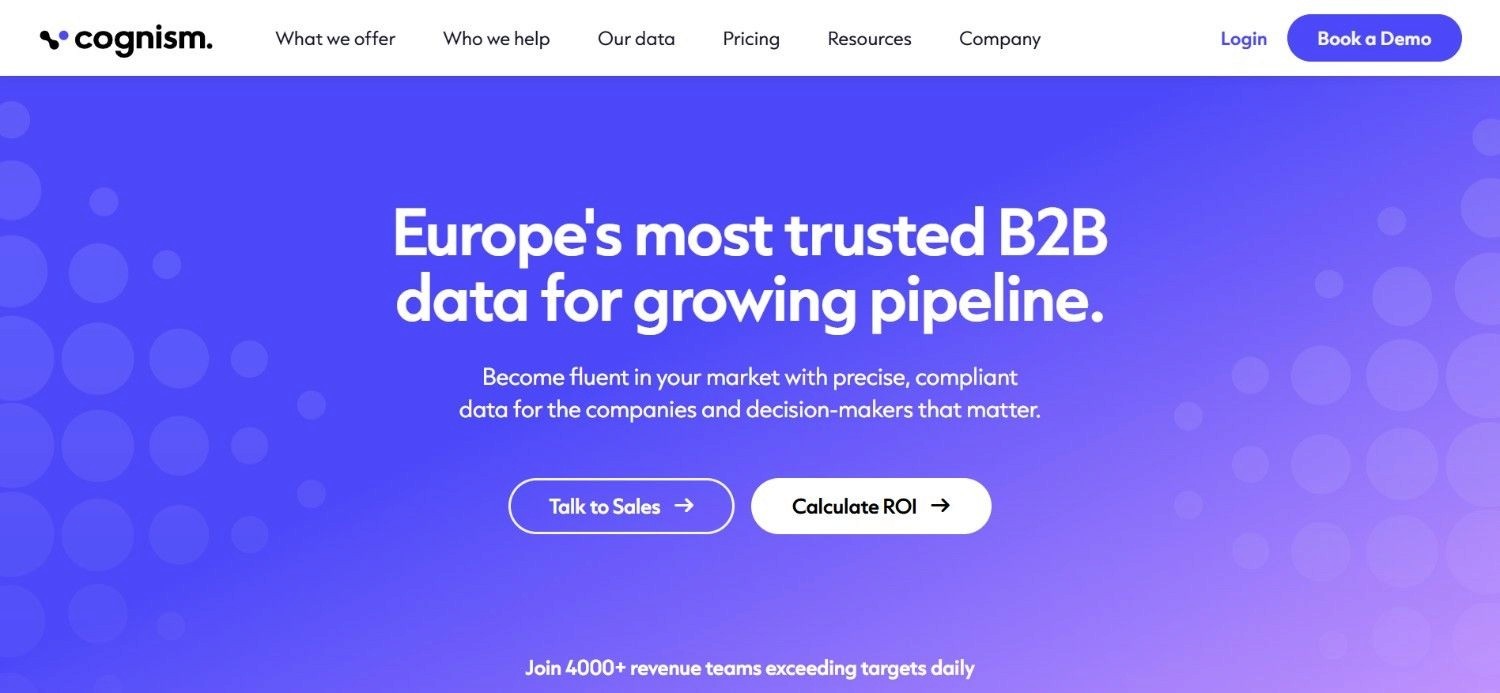
Cognism built its reputation on verified phone and mobile data, which matters for teams running a call-heavy outbound motion in regions where email alone does not convert well. As a B2B intelligence platform, it leans into that verification layer more than most competitors do.
The platform combines verified contact data with intent signals and sequencing, positioning it alongside Apollo as a strong option for SMB and early-stage teams building their first real outbound engine.
Coverage skews particularly strong in Europe, which makes Cognism a common pick for companies selling into UK and EU markets specifically, alongside its US data.
Ideal For
Teams running phone-heavy outbound who need verified mobile numbers
Companies selling into European markets specifically
SMB and early-stage teams building their first outbound motion
Top Features
Diamond data verification process for phone and mobile accuracy
Intent signals layered on top of contact and company data
Built-in sequencing for outbound campaigns
Why They Stand Out?
Cognism's phone data verification process is a genuine differentiator for teams where a connected call matters more than an email open rate.
Pros
Strong verified phone and mobile data accuracy
Solid European data coverage alongside US contacts
Combines data, intent signals, and sequencing in one platform
Cons
Higher entry cost than Apollo for teams just getting started
Less flexible than Clay for teams wanting custom workflows
Not built for the scale enterprise teams typically need
Pricing
Cognism's Sales Prospecting plans start at $14,000 per year (Standard) and $18,750 per year (Pro), with 5 seats included. Pricing is subscription-based, with additional Cognism Credits available separately for contact reveals, enrichment, and exports.
Final Verdict
Cognism fits SMB and early-stage teams, particularly those running phone-heavy outbound or selling into European markets.
Teams needing enterprise scale or a more customizable sales intelligence platform will likely outgrow it.
5. Amplemarket
Overview
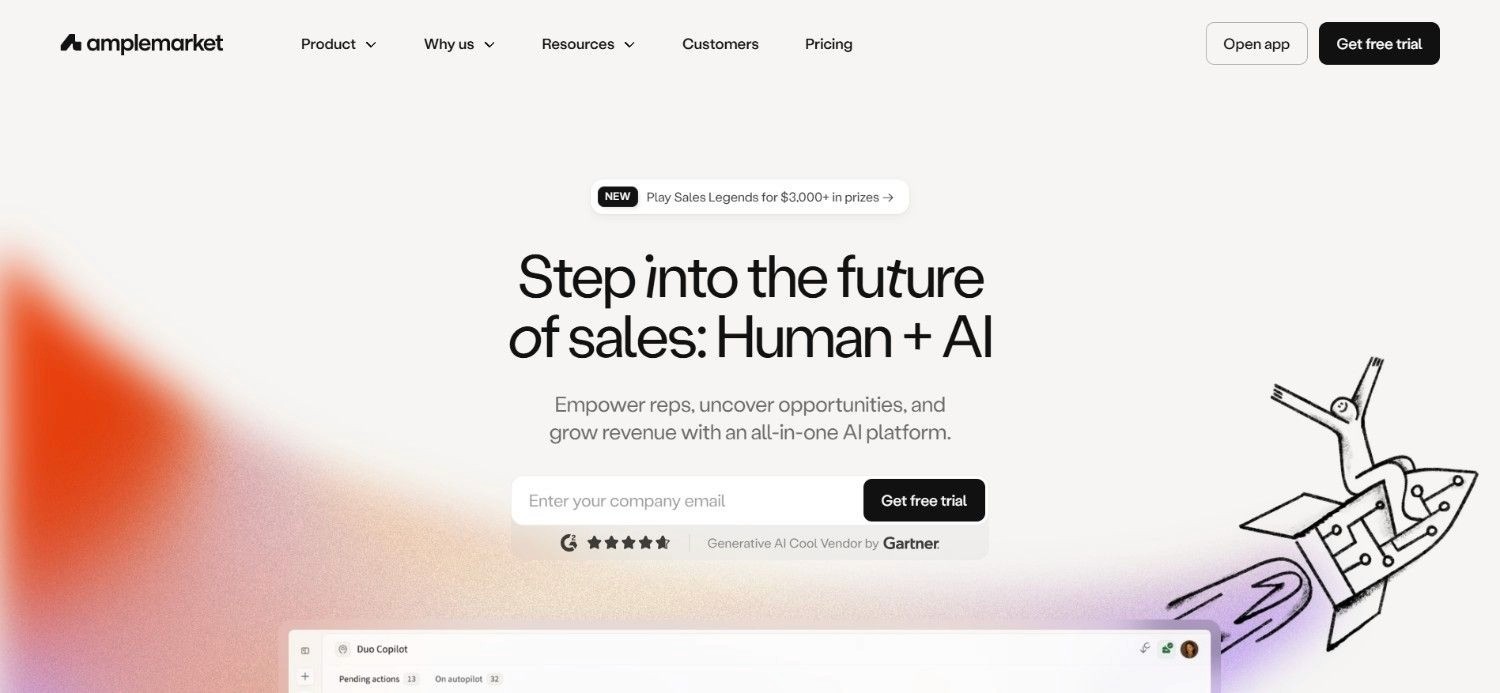
Amplemarket has been gaining attention as an up-and-coming revenue intelligence platform that consolidates signals, data, sequencing, and rep tooling into a single platform, rather than requiring a team to stitch several tools together.
The pitch is consolidation done well: one platform for AEs and SDRs, with LinkedIn connections, job change alerts, and a range of buying signals all surfaced in one place instead of scattered across separate subscriptions.
That breadth is also the platform's biggest challenge. Configuration is not straightforward, and teams should expect a real ramp-up period before the platform runs the way they want.
Ideal For
Teams wanting signals, data, and sequencing consolidated in a single platform
Sales orgs with both AEs and SDRs who want a shared, unified tool
Companies willing to invest setup time for a more consolidated workflow
Top Features
Unified inbox and signal tracking across LinkedIn, email, and job changes
AI-assisted SDR features for research and outreach personalization
Broad signal coverage spanning multiple data sources in one dashboard
Why They Stand Out?
Amplemarket's consolidation strategy sets it apart from platforms that specialize in one layer of the stack.
Instead of choosing a database tool and a separate sequencer, teams get both under one roof.
Pros
Consolidates data, signals, and sequencing into a single platform
Strong signal coverage across LinkedIn, job changes, and other buying indicators
Built for both AE and SDR workflows in one shared system
Cons
Configuration is genuinely difficult and takes real time to get right
Cost increases noticeably as team size and usage scale
The broad feature set can slow down day-to-day ease of use
Pricing
Amplemarket's Startup plan starts at $600 per month on an annual contract and includes 2 users. Growth and Elite plans use custom pricing, adding more users, larger contact allowances, advanced AI features, personalized onboarding, and dedicated customer success for scaling teams.
Final Verdict
Amplemarket suits teams that want a consolidated tool and are willing to invest the setup time to get there.
Teams wanting something simpler to configure out of the box may prefer Apollo or Cognism instead.
How to Choose the Best Option (What to Consider)?
Choosing the right lead intelligence platform comes down to a handful of factors that matter more than any single feature on a vendor's website:
1. Match the Platform to Company Stage
An enterprise-grade lead intelligence platform like ZoomInfo overshoots what a 5-person team needs, and a lightweight SMB tool underserves a 500-person sales org.
Map your current stage honestly before evaluating vendors, since the right fit changes as a company grows.
2. Confirm Who Will Actually Configure It
Some platforms, like Clay and Amplemarket, need real setup time and ongoing maintenance to perform well.
Ask directly whether someone on the team has the bandwidth to own that setup, or whether the budget needs to include outside help.
3. Compare Contract Length and Flexibility
Enterprise platforms commonly require a one-year minimum, and reps often push multi-year deals to bring the price down.
Decide upfront how much contract flexibility your team actually needs before a sales conversation starts.
4. Evaluate Data Depth Against Actual Use Case
More data is not automatically better. A phone-heavy outbound motion needs verified mobile numbers more than it needs a massive firmographic dataset.
Match the platform's core strength to how your team actually reaches out to prospects.
5. Check How the Platform Fits Your Existing Stack
A tool in this category rarely operates alone. It needs to write data into a CRM and often feed a sequencing tool downstream.
Before committing, confirm how the platform's data actually reaches your team, since that connective layer is where most of the setup complexity in this category actually lives.
If you still need to build a scalable GTM stack starting with the CRM layer, that decision, like the comparison between HubSpot vs Salesforce, should happen before locking in a data provider.
6. Factor In Setup Cost, Not Just the Subscription
The sticker price rarely reflects the total cost of a lead intelligence platform.
A tool that needs weeks of configuration carries a real cost in time, even if the monthly fee looks reasonable on paper.
7. Decide How the Data Reaches Reps
A prioritized lead means nothing if it sits inside a tool nobody checks.
Confirm how enrichment and scoring data actually reaches the reps doing outreach, whether that is a CRM sync, an alert, or a downstream sequence in your B2B outreach tools.
Everything You Need to Know About Lead Intelligence Platforms
Here's how each lead intelligence platform stacks up side by side, once pricing, setup effort, and everyday usability are all factored in together:
Tools | Pros | Cons | Ease of Use | Integrations | Support | Affordability |
ZoomInfo | Deepest database, GTM Studio, strong intent data | Long contract, high cost, overkill for small teams | ⭐⭐⭐⭐ | ⭐⭐⭐⭐⭐ | ⭐⭐⭐⭐ | ⭐⭐ |
Clay | Most flexible, broad integrations, scalable workflows | High setup effort, needs expertise, credit costs add up | ⭐⭐ | ⭐⭐⭐⭐⭐ | ⭐⭐⭐ | ⭐⭐⭐⭐ |
Apollo.io | Affordable, all-in-one, fast setup | Limited data depth, matures out of it quickly | ⭐⭐⭐⭐ | ⭐⭐⭐ | ⭐⭐⭐ | ⭐⭐⭐⭐⭐ |
Cognism | Verified phone data, strong EU coverage, intent signals | Higher entry cost, limited flexibility, SMB scale | ⭐⭐⭐⭐ | ⭐⭐⭐ | ⭐⭐⭐ | ⭐⭐⭐ |
Amplemarket | Consolidated platform, strong signals, AE and SDR fit | Hard to configure, cost scales fast, feature-heavy | ⭐⭐ | ⭐⭐⭐⭐ | ⭐⭐⭐ | ⭐⭐⭐ |
Where The GTM Engineering Company Fits In Here?
The GTM Engineering Company is not another entry on this list. It is not a data or intelligence platform, and it is not an agency either.
Most growth-stage teams have already bought the CRM, data provider and outbound platform.
The tools above are components, and they don't naturally talk to each other, with expensive platforms often ending up used at only 20 to 30 percent of their actual capacity.
Beyond the tools, you also need a GTM engineer who can connect the pieces together: mapping fields, building the scoring logic and making sure enrichment data actually reaches a rep instead of sitting in a table nobody opens.
That's exactly the layer The GTM Engineering Company operates in: making the tools you already own work as a singular system. If your stack already includes 2 or 3 of the tools above and they still are not talking to each other, that is worth a closer look before buying another lead intelligence platform.
Request the 30-day audit to see how much of your current stack, not a new one, is actually usable, and how The GTM Engineering Company can help you scale it while scaling your GTM efforts.
FAQs About Lead Intelligence Platforms
What is the best lead intelligence platform in 2026?
The best lead intelligence platform in 2026 depends on the company stage more than any single feature list. ZoomInfo remains the strongest choice for enterprise teams needing the deepest contact database, while Clay offers the most flexibility for mid-market teams with the capacity to build custom workflows. Apollo and Cognism suit SMB teams wanting one accessible tool.
What should I consider when choosing the right lead intelligence platform for me?
You should consider company stage, internal technical capacity, and contract flexibility before comparing feature lists. A platform that needs heavy configuration, like Clay or Amplemarket, only delivers value if someone can actually build inside it. Enterprise platforms like ZoomInfo typically require a one-year contract minimum, while SMB tools like Apollo and Cognism offer more flexible, lower-commitment pricing.
How does The GTM Engineering Company differ from the platforms in this list?
The GTM Engineering Company does not compete with the tools reviewed here. It is the engineering layer that connects a CRM, a data provider, and an outbound platform so they function as one system instead of 5 disconnected subscriptions. Most growth-stage teams already own enough tools; the gap is usually someone to make them work together, not another platform.
How do I get started working with The GTM Engineering Company?
Getting started begins with a 30-day audit of your existing stack, not a recommendation to buy another lead intelligence platform. That audit produces a documented punch list, a working enrichment table, and at least one operational signal live in your CRM within the first 30 days. From there, engagements run as 3 or 6-month retainers with weekly working sessions inside your own systems.
How easy is it to switch between lead intelligence platforms?
Switching platforms is rarely as simple as canceling one subscription and starting another, since contact data, scoring logic, and CRM field mappings all need to migrate. Enterprise tools like ZoomInfo add friction here because of their contract length, while lighter tools like Apollo make switching faster but still require remapping data into your CRM.
Is Clay or Apollo the better lead intelligence platform for a small team?
Apollo is generally the better fit for a small team that wants a working setup fast without a technical build process. Clay works better once a team has the internal expertise, or budget for outside help, to build custom enrichment workflows rather than use a fixed feature set. A well-built Clay workflow tends to outperform Apollo's fixed structure once running.
Why does lead intelligence data go stale so quickly?
Lead intelligence data goes stale primarily because people change jobs constantly, and most CRMs never catch it. Industry estimates put contact decay at 40 to 60 percent, meaning a meaningful share of any CRM's contact base has already moved to a new company without the record updating. This is why ongoing enrichment matters more than a one-time data purchase.
Are all-in-one platforms like Amplemarket replacing dedicated data providers?
All-in-one platforms are gaining ground, but they have not fully replaced dedicated data providers, since depth and breadth often trade off against each other. Amplemarket and similar consolidated tools appeal to teams wanting fewer subscriptions to manage, though the tradeoff is usually a steeper setup curve and less depth than a dedicated provider like ZoomInfo or Cognism offers.
Should we hire someone full-time to manage our lead intelligence platform, or bring in outside help?
That's its own decision, depending mostly on how much ongoing configuration your stack needs. A full-time hire makes sense once there is enough recurring workflow-building work to justify a salary. An outside or fractional team fits better when that expertise is needed in bursts. This tradeoff is covered in the fractional RevOps vs. RevOps agency comparison.