

Most of the buyers who read your pricing page never tell you they were there. Website deanonymization tools close that gap by putting a script on your site, reading the visitor's IP address or device fingerprint, and matching it to a company or a named person before the session ends.
This review covers ten options, what each one actually resolves, what it costs, and where its geography limits start. It also covers what to do with the name once you have it, which is where most deployments stall.
Key Takeaways (TL;DR)
The Best Overall Website Deanonymization Setup: The GTM Engineering Company builds the identification, filtering, and routing layer inside your own CRM, so the signal reaches a rep instead of a dashboard. For teams who want a single vendor to buy instead, Warmly is the strongest person-level product and RB2B is the cheapest way to test the signal.
Why Do You Need It: Your form captures a fraction of the buyers who arrive with intent, and the rest leave no record you can act on. Deanonymization turns that traffic into named accounts and contacts your team can qualify, route, and sequence the same day.
Who It's For: B2B teams with a defined ICP, a high-value product, and enough traffic that manual review isn't possible. It's a weak fit for consumer traffic, pre-product-market-fit startups, and companies whose audience sits mostly in the EU.
How to Choose the Right One: Decide first whether you need account-level or person-level resolution, because person-level identification is limited to US traffic at every major vendor. Then check the coverage band on the specific plan you're buying, and confirm the signal can reach your CRM and your sequencer without a manual export.
Expected Price: The GTM Engineering Company runs 3 or 6-month retainers at $4K/mo for Starter and $6K/mo for Growth, with custom Enterprise pricing. Standalone tools span a wide range, from RB2B's free tier and $79/mo Starter plan up to $30,000 a year for Warmly's top tier and six figures for enterprise contracts with 6sense or Lead Forensics.
Table of Contents
Top Website Deanonymization Tools in 2026 at a Glance
What Are Website Deanonymization Tools?
Why Do You Need Website Deanonymization Tools?
Who Needs Website Deanonymization Tools?
Best Website Deanonymization Tools: In-Depth Review & Comparison
How to Choose the Best Website Deanonymization Tools
Everything You Need to Know About Website Deanonymization Tools
Build Your Visitor Identification Layer with GTM Engineering
FAQs About Website Deanonymization Tools
About the Author
Top Website Deanonymization Tools in 2026 at a Glance
Company | Best For | Key Features | Pricing |
The GTM Engineering Company | Teams who have the signal but no system to act on it | Vendor selection, ICP filtering in Clay, CRM routing rules, Slack alerts to the right rep, job-change tracking, documented SOPs | $4K/mo Starter, $6K/mo Growth, Enterprise custom, on 3 or 6-month retainers |
Warmly | Person-level identification with same-session engagement | Contact and company identification, ICP filtering, real-time Slack alerts, lead routing, CRM sync, AI chat agents, warm calling | From $10,000/yr AI Web-Deanonymization, $20,000/yr Inbound Chat, $30,000/yr AI Inbound Autopilot, each from 10K credits/mo |
RB2B | The cheapest way to test whether the signal is worth it | US person-level contact ID, LinkedIn URLs and business emails pushed to Slack or Teams, global company-level ID | Free for 150 resolutions, $79/mo Starter, from $149/mo Pro, from $199/mo Pro+ |
Vector | Marketing teams who want to identify ad clickers, not only site visitors | Ad Reveal for paid clicks, site deanonymization, contact-level ad audiences, Salesforce and HubSpot sync | $399 to $999/mo for Reveal by visitor volume, from $3,000/mo for Target |
Factors.ai | Account-level identification with waterfall enrichment and attribution | Waterfall IP-to-company enrichment, account scoring, journey analytics, LinkedIn ads analysis, CRM sync | Free trial then $199/mo for Lite, $6K/yr Basic, $20K/yr Growth, from $30K/yr Enterprise |
Apollo | Teams who want identification, enrichment, and sequencing in one bill | Company-level ID on the free plan, US contact-level ID via the Inbound add-on, 65+ enrichment fields, trigger-based routing | Company-level included on the free plan, contact-level requires the Inbound add-on |
HubSpot Breeze Intelligence | HubSpot customers who want intent data without a second contract | Company-level buyer intent inside the CRM, target-market filtering, visitor and research tabs, native workflow triggers | Credits included with your existing subscription, extra bought as capacity packs, on Starter tiers and above |
Leadfeeder (formerly Dealfront) | European traffic and EU-based company-level identification | Company reveal, real-time account alerts, CRM push, intent filters, verified emails and phones on higher tiers | €0 Lite, from €79/mo Discover, from €369/mo Activate, from €599/mo Scale (annual rates), Enterprise custom |
Lead Forensics | Enterprise teams that want unlimited seats on company-level data | IP-to-company identification, full firmographic detail, decision-maker contact data, unlimited user access | Quoted on traffic volume and leads uncovered, after a free trial |
6sense | Mature ABM programs that need predictive intent, not only site traffic | Predictive AI account scoring, off-site intent, Sales Copilot, web visitor identification, CPM-bid advertising | No published subscription pricing, quoted on request across three Sales Intelligence configurations |
What Are Website Deanonymization Tools?
Website deanonymization tools identify the companies and people visiting your site who never fill in a form. You install a script in your site header, and from then on each session gets matched against a vendor's identity data and returned to you as a company record, a named contact, or both.
The mechanics are the same across every vendor in this review. The script reads the visitor's IP address or a device fingerprint, matches it against an identity graph, and delivers the enriched record back into the tool's own interface or pushes it out over a webhook to somewhere you can act on it.
Where vendors differ is what they resolve the visit to. Account level visitor identification returns the company, which works globally because a company IP address isn't personal data in the same way a name is. Person level visitor identification returns an individual, and every major vendor limits it to United States traffic.
The category has two other names you'll see in the same searches. De-anonymization software and b2b visitor identification tools describe the same products, and website visitor tracking b2b is how most vendors describe the underlying data collection.
It sits next to the broader lead intelligence platforms category, which covers firmographic and contact data whether or not the person visited your site.
The category itself changed shape in 2026. Three of the best-known products in adjacent parts of the inbound stack were bought or retired inside seven months, which is covered in the buyer's guide below because it now affects which contract you should sign.
Why Do You Need Website Deanonymization Tools?
Your website converts a small share of the people who arrive on it, and the rest leave no usable record. Ruler Analytics analyzed more than 5 million conversions across 13 industries and put the overall average conversion rate at 5.13%, with software and SaaS sites at 7.6%. Everything else is traffic you paid for and can't follow up.
A director of RevOps at a Series B company can watch traffic climb quarter over quarter and still have no answer when the CEO asks which target accounts looked at pricing last month. Traffic growth on its own doesn't tell anyone who to call.
The first outcome of deanonymization changes is speed to the right conversation. When the account is named inside the session, an AE can open the CRM record, see there's an open opportunity, and call the same afternoon rather than finding out three weeks later in a form fill.
The second outcome is recovering leads you already paid for but couldn't use. One high-growth AI company we worked with, WebAI, was capturing inbound submissions with personal email addresses, which left the high-value contacts invisible in the CRM. After we built personal-email de-anonymization plus ad-click and visitor tracking pushed to sales, 1 in 5 inbound leads came back as qualified ICP.
The third outcome is knowing what your demand actually looks like. Identified visitors who fall outside your ICP still tell you which companies are researching your category, and a contact who visits today and changes jobs in eight months becomes a warm account at a new logo if you kept the record.
Who Needs Website Deanonymization Tools?
Deanonymization pays back where deal values are high and the buying committee is large enough that one form fill never represents the whole account. It also needs more traffic than anyone can review by hand. These are the five teams that get the most out of it, and they're the same teams we build these systems for.
Directors and VPs of Revenue Operations
You've inherited a CRM, an enrichment tool, an outbound sequencer, and a scoring layer that don't talk to each other, and you have about 90 days to prove ROI.
Visitor identification is one of the fastest signals to stand up, because the script goes live in an afternoon and the routing logic is where the real work sits. What you need from a vendor is a clean webhook and a CRM object model that won't create duplicate contacts.
Founders and CEOs at growth-stage B2B SaaS
You're funding infrastructure instead of another BDR seat, and you want to know whether the traffic your content is generating includes anyone who can sign.
A free or sub-$100 tier answers that question in a month for the price of a team lunch. If the identified accounts are all students and job seekers, you've learned something useful and cheap.
CROs and VPs of Sales
Your reps work accounts off instinct because nothing ranks them. Identification gives you an intent layer that sits on top of ICP fit, so a rep opens the day with the five accounts that read a pricing page rather than the five they remember.
The routing rules matter more than the match rate here, because a signal that lands in a shared inbox gets ignored.
Directors of Marketing Operations and VPs of Growth
You're defending paid spend and you can only see form fills. Vector's ad-click identification and Factors' journey analytics both exist for this, and they answer a different question than a sales-first tool does. You want to know which campaigns brought in-ICP companies to the site, whether or not anyone converted.
Enterprise ABM and demand-gen teams
You already buy third-party intent data and run account-based advertising, and site identification is the on-site half of that picture. Your constraint is usually CRM data hygiene rather than coverage, because an identity feed pointed at a messy database creates thousands of orphaned records.
This is the segment where account level visitor identification plus strict deduplication beats person-level volume.
Best Website Deanonymization Tools: In-Depth Review & Comparison
Each entry below covers who the product suits, what it resolves visits to, what it costs on the vendor's own published pricing, and where it stops. Pricing and geography limits were checked against each vendor's live pages in September 2026.
1. The GTM Engineering Company
Overview
The GTM Engineering Company builds the technical infrastructure behind a working revenue engine, and visitor identification is one of the signals it wires in. It isn't a deanonymization vendor, so it belongs at the top of this list for a different reason than the other nine entries.
Every tool below hands you a name, and almost every team that buys one discovers within a quarter that the name is the easy part.
Founded by Jorge Macías, a Y Combinator S18 alumnus and Clay Expert Program member, the company works as an embedded fractional GTM engineer inside the client's own CRM. Engagements run as 3 or 6-month retainers with weekly working sessions, and every workflow ships with an SOP and a Loom walkthrough so the client's team owns it afterward.
The work covers vendor selection, ICP filtering, CRM routing, and the deduplication rules that stop an identity feed from wrecking your database.
Ideal For
VC-backed B2B SaaS companies from post-seed through Series C, in the $1M to $30M ARR range and sweetest between $3M and $15M, with no in-house RevOps engineer
RevOps leaders 3 to 12 months into a new role with a mandate to modernize a fragmented stack
Teams already paying for a deanonymization tool whose identified visitors aren't reaching a rep
Enterprise sales orgs on Salesforce or HubSpot running ABM motions with complex stakeholder selling
Marketing ops leads who need identified visitors to reconcile against paid spend and attribution
Top Features
Vendor selection and instrumentation: We pick the identification tool that matches your traffic geography and deal size, then install and test it so you aren't paying for coverage you can't use.
ICP filtering in Clay: Identified companies get scored against firmographics, headcount growth, job postings, and technographics before anyone sees them, using the same lead scoring models we build for CRM records.
CRM routing that fires on the visit: Rules check whether the visitor already exists, whether there's an open opportunity, and who owns the account, then alert the right person in Slack instead of creating another queue.
Job-change tracking on identified contacts: Contacts who visit and later move companies get stamped and re-enriched, so a visit today becomes a warm account at a new logo later.
Documented systems you keep: Every table, workflow, and field ships with an SOP and a Loom, so the build survives the engagement ending and the next hire can extend it.
Why We Stand Out?
Most teams buy a deanonymization tool, connect it to Slack, and stop there. The value shows up in the branch logic that runs after the match. The play we implement checks the identified visitor against the CRM first. If they aren't in it, we qualify whether the account is tier one, and if it is, we create the contact and start outreach that week.
If it isn't, we keep the record for job-change tracking and demand mapping rather than discarding it.
The branches for visitors who are already in the CRM matter just as much. An open opportunity routes to the owning rep, a customer routes to the account manager or CS rep, and an uncontacted lead goes back into a sequence, because a visit is evidence that the timing changed.
That branch logic sits on top of Clay automation and lands in your CRM, which is why we build it inside your stack rather than in a vendor portal. The proof is in the numbers our clients report. Spara got automatic account tiering plus inbound intelligence delivered to Slack, with enrichment backfilled across roughly 6,800 companies, and the documented outcome was hours of inbound research saved per week.
Pros
Tool-agnostic by design: We recommend the vendor that fits your traffic and stack rather than reselling one, so you can change tools later without rebuilding the routing.
The routing layer is the deliverable: You get working branch logic in your CRM, not a dashboard and a punch list.
Transparent pricing: $4K/mo Starter and $6K/mo Growth, with the CRM audit included in the retainer rather than billed as a separate SOW.
Cost-engineered enrichment: One client processed 18,000 leads for roughly $38 by routing classification through OpenAI instead of Clay credits.
You own the system: SOPs and Loom walkthroughs on every workflow, so your team can operate and extend the build without us.
Cons
We're a retainer, not a subscription: A 3-month engagement at $4K/mo costs more upfront than a $79/mo tool, so it's the wrong first purchase if you don't yet know whether the signal is useful.
Pre-PMF companies are out of scope: We come in to scale a working motion rather than to find one, and we'll refer you out if the motion isn't there yet.
Capacity is limited: Monthly client slots are capped to protect the weekly working-session model, so start dates aren't always immediate.
Pricing
Four packages across two contract lengths and two intensity levels. Three-month terms run $4K/mo for about 24 hours or $6K/mo for about 40 hours, and six-month terms run $4K/mo for about 27 hours or $6K/mo for about 46 hours. Every tier includes a 2-hour weekly working session plus async build time, and the public site simplifies this to Starter at $4K, Growth at $6K, and custom Enterprise pricing. The CRM audit is part of the retainer.
Final Verdict
If your problem is that you can't see who's on your site, buy one of the tools below and start with the cheapest tier. If your problem is that you can already see them and nothing happens next, the build is the missing piece, and that's what we do. Fit depends on having a working motion to scale, so a pre-revenue team should spend the first $79 on RB2B before spending $4K on us.
2. Warmly
Overview
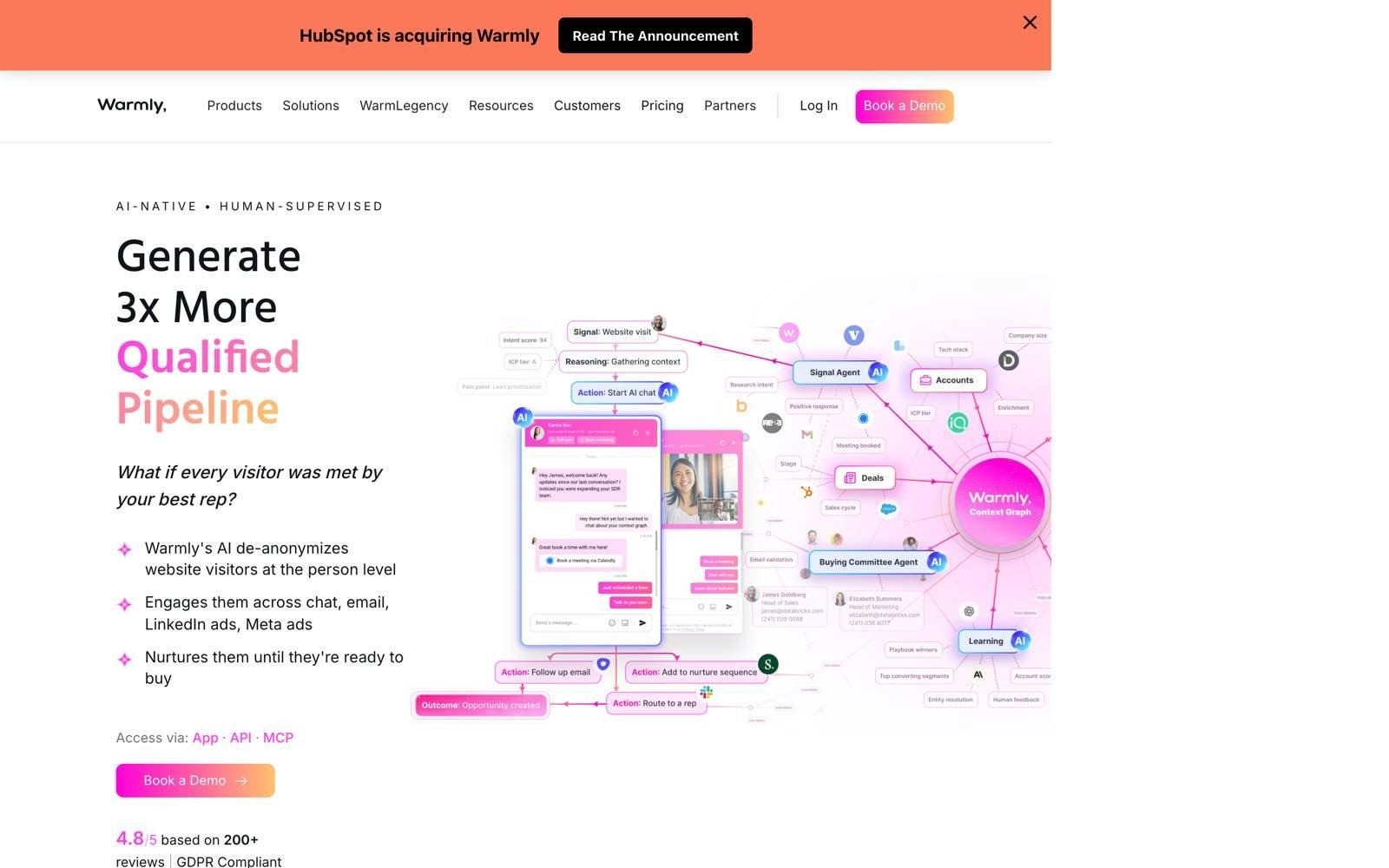
Warmly is an AI-native go-to-market product built around person-level website identification and same-session engagement. It identifies the companies and named contacts on your site, filters them against your ICP, syncs them into your CRM, and routes them to an AE or SDR, with real-time Slack alerts as the default delivery.
The engagement layer is what separates it from a pure identification feed. Alongside the alerts, Warmly runs AI chat agents that can open a conversation with an in-ICP visitor while they're still on the page, and a rep can take over the chat or move straight into a call.
On June 30, 2026, co-founder and CEO Max Greenwald announced that Warmly had entered into an agreement to be acquired by HubSpot, which changes the evaluation for anyone signing a new annual contract.
Ideal For
US-heavy B2B SaaS teams that want named contacts rather than company names
Sales teams with the coverage to work a live inbound signal within minutes
HubSpot customers, given the acquisition and Warmly's stated ambition to connect across HubSpot's product line
AEs and SDRs who want an alert in Slack with enough context to dial immediately
Marketing teams running retargeting off identified in-ICP visitors
Top Features
Person-level identification with ICP filtering: Named contacts arrive pre-filtered against your criteria, so the alert channel stays workable instead of turning into a firehose.
Lead routing built into the entry tier: Routing sits alongside the alerts on the cheapest plan, so the identified contact reaches an owner without a separate workflow tool.
Real-time Slack alerts and CRM sync: The visit reaches the owning rep and the CRM record in the same moment, which removes the export-and-upload step most cheaper tools leave you with.
AI chat agents with human handoff: An agent can engage an in-ICP visitor mid-session, book the meeting, or hand the conversation to a rep who takes over and dials.
Warm calling and warm offers: Higher tiers add call and offer workflows triggered by the visit itself rather than by a list.
Configurable consent placement: Warmly's documentation states that customers can place both the JavaScript and the cookie behind a cookie banner, or place just the cookie behind it while the JavaScript fires.
Why They Stand Out?
Warmly is one of the strongest choices for teams that want identification and engagement from the same vendor. Most tools in this category stop at the notification, and Warmly's chat agents let you act inside the session that generated the signal, which is the window where intent is highest.
Its compliance posture is also unusually well documented. Warmly's help center states that its providers do not match individual contacts inside the EU and only resolve US traffic, and that the JavaScript alone performs account identification without dropping a cookie. That gives a buyer with European traffic a clear picture of what they will and won't get, which is more than most vendors publish.
Pros
Person-level identification paired with same-session AI chat from one vendor
Slack alerts and CRM sync included at the entry tier rather than gated behind an upgrade
Published, itemized annual and quarterly pricing rather than quote-only sales conversations
Clear documentation on consent placement and on the limits of EU person matching
Retargeting included at the entry tier, with GTM Signals and Warm Experiences add-ons at $10,000 a year each
Cons
Entry pricing starts at $10,000 a year, which is a serious commitment relative to the sub-$200/mo tier of the category
The engagement features that justify the price sit on the $20,000 and $30,000 tiers
Person-level matching is scoped to US traffic, so EU-heavy audiences resolve at company level only
The roadmap owner is now a CRM vendor, so teams standardized on Salesforce should ask where Warmly sits in HubSpot's plans before signing a multi-year term
The AI chat layer needs someone to own prompts, offers, and escalation rules, which is a real internal cost
Pricing
Warmly publishes three annual tiers, each quoted as a starting price and each beginning at 10,000 credits a month. AI Web-Deanonymization starts at $10,000 a year and covers website visitors at contact and company level, ICP filtering, real-time alerts, Slack alerts, lead routing, CRM sync, SEP and webhook integrations, and retargeting by email, LinkedIn, or ads. Inbound Chat starts at $20,000 a year and adds the AI chatbot with one AI Studio agent, warm calling, warm offers, chat metrics, and automated email follow-up.
AI Inbound Autopilot starts at $30,000 a year and adds unlimited AI Studio agents, an autopilot agent handling goal-setting and qualification, and AI slide generation.
Quarterly equivalents run $4,875, $6,500, and $9,750. Two add-ons are priced at $10,000 a year each, the GTM Signals Package and Warm Experiences, and a third, an AI 24/7 video chat agent, is quoted on request.
Final Verdict
Warmly is the pick for US-focused sales teams that want person-level identification and want to engage the visitor before they leave, and it's the most complete single-vendor answer in this review.
It's a weaker fit for EU-heavy traffic, for teams whose budget stops well below $10,000 a year, and for anyone who needs certainty about a standalone roadmap, since the product is now owned by HubSpot and Warmly's own announcement frames deeper integration as the ambition.
3. RB2B

Overview
RB2B describes itself as the simplest, fastest, easiest, and least expensive path to the website visitor signal, and the product is built around exactly that. You install a pixel in your site header, connect Slack or Teams, and identified visitors start arriving as names, LinkedIn profiles, and business email addresses.
It's the standard first purchase in this category and the reason most searches for rb2b alternatives start from a price comparison rather than a feature gap. The free tier covers 150 monthly resolutions at company level, and paid plans start at $79 a month, which makes it the cheapest realistic way to find out whether your traffic contains anyone worth calling.
Ideal For
Teams testing whether website deanonymization produces anything useful for their ICP
Founder-led sales motions with US-heavy traffic and no ops headcount
Slack-first sales teams that want LinkedIn URLs they can act on immediately
Companies with an in-house operator willing to configure and debug the integrations
Agencies and consultants who need a low-cost signal across several client sites
Top Features
US person-level contact ID: Names, LinkedIn profiles, and business email addresses for US visitors, delivered per resolution rather than per seat.
Slack and Teams delivery out of the box: LinkedIn URLs push straight into a channel, which is the fastest path from visit to outreach without touching a CRM.
Global company-level ID: RB2B's help center states that company-level identification operates globally by default, including visitors from outside the United States and across the EU.
Integration coverage at the Pro tier: Clay, HubSpot, Salesforce, Zapier, Apollo, webhook, and CSV, which is enough to wire the signal into an existing stack.
Five-minute setup with a 7-day full-featured trial: The trial is listed across all four tiers, so you can measure your own resolution volume before committing.
Why They Stand Out?
RB2B is one of the smartest ways to buy into this category on a small budget. The free and $79 tiers make it a genuine test rather than a procurement exercise, and the setup is fast enough that a founder can have the signal in Slack the same day.
Its geography documentation is also specific. RB2B states that its Person-Level Identity is a US-only technology with a US-only database, that person-level identification is never performed outside the United States, and that a company outside the US can use person-level ID on its US traffic.
Pros
The lowest entry price in the category, including a free tier with 150 monthly resolutions
Person-level output at $79 a month, which most competitors gate behind four-figure contracts
Setup measured in minutes, with a 7-day full-featured trial on every plan
Broad integration list at the Pro tier, including Clay, HubSpot, Salesforce, and Apollo
Explicit published documentation on where person-level and company-level identification apply
Cons
The 70-80% resolution figure is the combined RB2B and Demandbase number per the banner on their own pricing page, while the same page's plan table lists contact-level coverage at 15-20% on Starter and Pro and 35-45% on Pro+, so read the band on the tier you're buying
Business email addresses and integrations beyond Slack and Teams require the $149 Pro tier
The published support stack is a self-serve knowledge base, AI chat, AI email, and human escalation, and there is no published implementation or custom-build service, so someone on your side owns the configuration and the debugging
Person-level identification is US-only, which rules it out as the primary tool for EU-heavy traffic
RB2B's documentation states that it does not enforce consent on your behalf and that you're responsible for consent configuration, which means global company-level tracking needs a consent management tool
Pricing
Four tiers. Free is $0 a month for 150 monthly resolutions with basic company-level ID pushed to Slack, and no person-level ID, emails, or integrations. Starter is $79 a month for 300 resolutions with LinkedIn URLs pushed to Slack and Teams.
Pro starts at $149 a month and adds business email addresses and all other integrations, with resolution tiers scaling from 600 upward. Pro+ starts at $199 a month and moves you to premium resolution, scaling as far as 2,500,000 monthly resolutions.
RB2B lists a 7-day full-featured trial across all four tiers, and it prices overage separately, at 45c per resolution on Starter and 25c on Pro and Pro+, with additional domains at $99 a month for up to five.
Final Verdict
RB2B is the right first purchase for a US-heavy team that wants to test whether the visitor signal is worth building around, and $79 a month is a cheap way to answer that.
Its support model is documented as a knowledge base plus AI chat and email with human escalation, so it suits teams with someone willing to own the setup and the debugging, and it isn't the right choice if you need EU person-level coverage, a managed implementation, or engagement features on top of the alert.
4. Vector
Overview
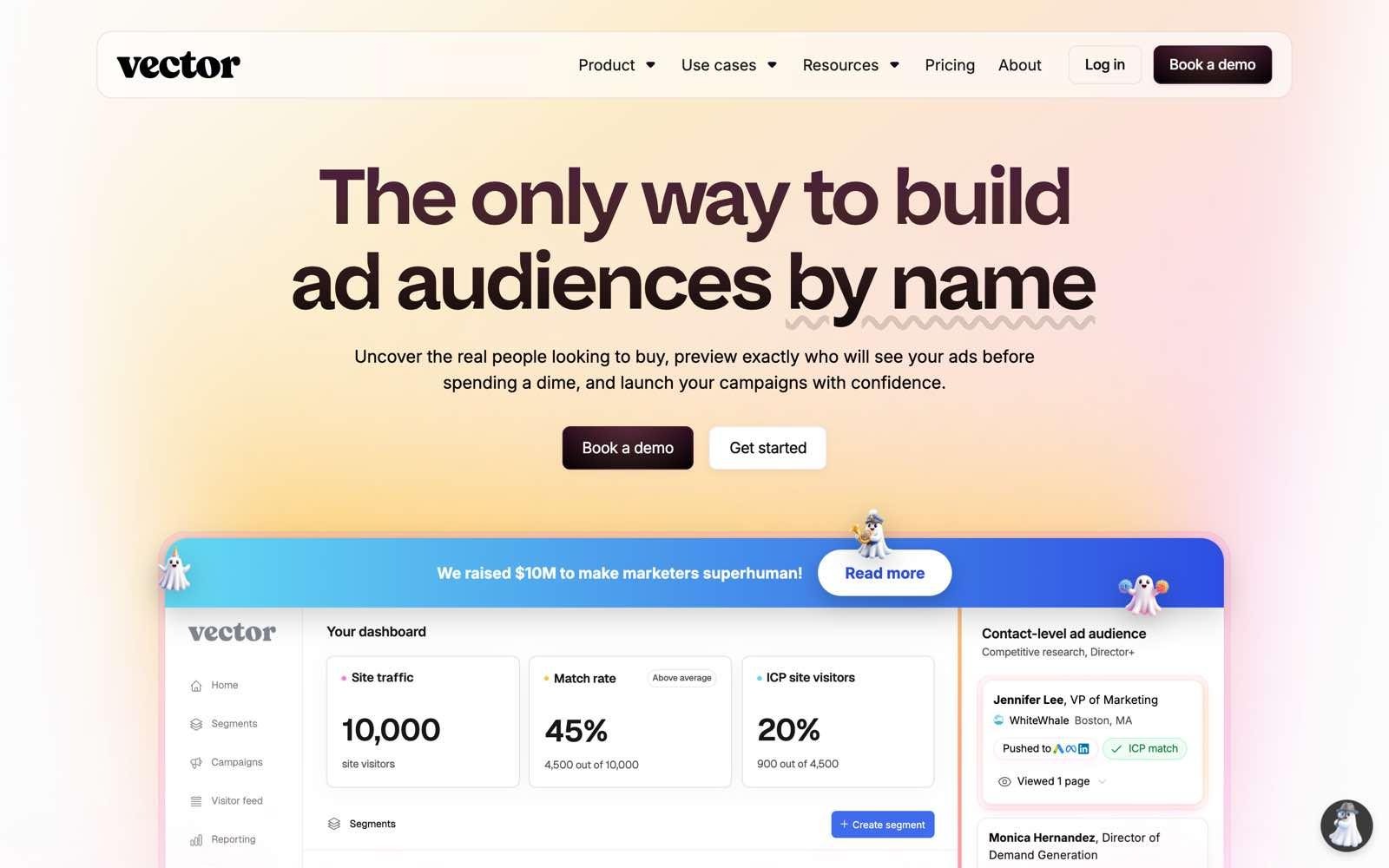
Vector deanonymizes website visitors, and it built its reputation on deanonymizing ad clickers. The product describes itself as the only way to build ad audiences by name, and the framing throughout is contact-level advertising rather than sales alerting.
That difference in emphasis matters when you're choosing. Vector's Ad Reveal shows the names of the people who click your ads even when they don't convert, and site deanonymization turns anonymous visitors into named contacts alongside it. The same underlying identity matching sits behind both, applied to a marketing question instead of a sales one.
Ideal For
Demand-gen and paid-media teams defending spend on LinkedIn and Google
Marketing ops leads who want to see which campaigns brought in-ICP companies to the site
Teams running account-based advertising who want audiences built from named contacts
US-only advertisers, given the geofence on the identity graph
Companies that want to test at $399 a month before committing to an annual audience contract
Top Features
Ad Reveal: Vector shows who clicks your ads even if they don't convert, which closes the biggest blind spot in paid B2B reporting.
Site deanonymization: Anonymous visitors resolve to named contacts, so the site and the ad channel share one identity layer.
Signal-driven audiences: On the Target tier, ad audiences refresh automatically as buyers visit specific pages, which keeps retargeting pointed at live intent.
Salesforce and HubSpot sync: Identified contacts push into the CRM directly rather than through a CSV, and the Target tier adds webhooks, custom CRM mapping, and UTM sync.
Fast deployment: Vector positions Reveal as live in days with chat and email support and a help center, and it opens with a free 14-day trial, so a test doesn't need an implementation project.
Why They Stand Out?
Vector is one of the strongest options for marketers rather than sellers, and that's a genuinely different product decision. Every other tool here answers "who visited the site," while Vector also answers "who clicked the ad and never came back," and the second question is the one that changes media budgets.
Its geography documentation is direct. Vector's security page states that it's geofenced to only operate in the United States, that it doesn't build any of its identity graph with information outside the US, and that it's therefore impossible to enrich a device fingerprint to an individual from a foreign jurisdiction.
Pros
Ad-click identification is rare in this category and answers a question site-only tools can't
A free 14-day trial and month-to-month Reveal pricing from $399 make a real test cheap and reversible
Native Salesforce and HubSpot sync at the entry tier
Signal-driven audiences on the Target tier keep paid retargeting tied to live page visits
Published, specific documentation on the US geofence and how the identity graph is sourced
Cons
The identity graph is US-only by design, so non-US traffic won't resolve to individuals at all
The Target tier that unlocks signal-driven audiences starts at $3,000 a month on an annual commitment
Positioning is built around advertising, so sales-side workflow features are thinner than Warmly's
Audience counts are the pricing lever on Target, which makes cost harder to forecast than a flat per-resolution model
Getting value from Ad Reveal assumes you're already spending enough on paid to have a click volume worth identifying
Pricing
Two tiers, both starting with a free 14-day trial. Reveal is usage-based on a monthly commitment and scales with identified visitors, at $399 a month for 2,500, $599 for 5,000, $799 for 7,500, and $999 for 10,000, with custom pricing above that. It covers Ad Reveal, site deanonymization, Salesforce and HubSpot sync, and chat and email support plus a help center.
Target starts at $3,000 a month on an annual commitment, includes 10,000 identified visitors, and adds signal-driven audiences, multi-channel ICP campaigns, webhooks, custom CRM mapping, UTM sync, personalized onboarding, a dedicated manager, and a dedicated Slack channel.
Target scales by audience count, at $3,000 for 25 audiences, $3,500 for 30, and $4,000 for 35, with custom pricing above that.
Final Verdict
Vector is the pick when the buyer is a marketing team and the question is paid performance, particularly if you want ad clickers identified alongside site visitors.
It's a weaker fit for sales-led teams that need routing, sequencing, and same-session engagement, and it's out of scope entirely for companies whose audience sits outside the United States.
5. Factors.ai
Overview
Factors.ai is an account-level identification and analytics product built around waterfall enrichment. Rather than resolving visits to individuals, it concentrates on identifying the companies visiting your site as accurately as possible, then layering scoring, journey analytics, and attribution on top.
The waterfall approach is the differentiator. Factors runs IP-to-company identification across multiple premium data providers in sequence rather than relying on one, and its own pricing page states that Basic tiers and above unmask over 75% of companies visiting your website.
Its published blog puts the mechanism at waterfall enrichment across four premium data providers to reach up to 75% identification on qualified ICP traffic.
Ideal For
ABM and demand-gen teams that need account-level identification with attribution attached
Companies with significant EU or non-US traffic, where person-level matching isn't available anyway
Marketing teams that want journey analytics rather than a stream of individual alerts
Teams evaluating LinkedIn ads performance against identified account behavior
Organizations with a data-hygiene mandate that rules out person-level feeds
Top Features
Waterfall IP-to-company enrichment: Multiple providers run in sequence instead of one, which raises match rates on the accounts you actually care about.
Account scoring and segmentation: Identified companies get scored and grouped, so the output is a prioritized account list rather than a visit log.
Journey analytics and attribution: Higher tiers give visibility across the buyer journey and multi-touch attribution, which connects identification to pipeline reporting.
LinkedIn ads analysis and audience sync: Enterprise tiers push audiences to Google and LinkedIn that refresh on their own, and add impression control.
Free entry point: Lite starts as a free trial with no card required and continues at $199 a month, so account-level identification can be tested without an annual contract.
Why They Stand Out?
Factors is one of the strongest choices for account level visitor identification, and its commitment to that level is deliberate rather than a limitation. Because company identification works globally, a Factors deployment behaves the same way for European traffic as it does for US traffic, which is not true of any person-level product in this review.
The analytics depth is the second reason teams pick it. Identification feeds account scoring and attribution inside the same product, so the marketing team can answer which campaigns brought in-ICP accounts without stitching a visitor tool to a BI layer.
For teams whose reporting problem is as big as their identification problem, that consolidation is worth real money.
Pros
Waterfall enrichment across multiple providers rather than a single IP database
Account-level focus works the same way globally, including EU traffic
Attribution and journey analytics built in rather than bolted on
Free trial and a $199/mo Lite tier make evaluation straightforward
Published pricing at every tier below Enterprise, which is uncommon in this part of the category
Cons
No person-level identification, so you'll never get a named contact from the visit itself
The analytics depth that justifies the price sits on the $20K/yr Growth and $30K/yr Enterprise tiers
Custom scoring, predictive scoring, and audience sync are gated to higher tiers
The product assumes a marketing owner, so a sales-led team may find the interface heavier than an alert feed
Company identification is capped per tier, at 1,500 a month on Lite and 3,000 on Basic, so a high-traffic site can hit the ceiling well before it hits the 75% match rate
Getting value from attribution requires clean CRM data going in, which is often a prerequisite project of its own
Pricing
Four tiers, and the published plan comparison caps usage on each. Lite is a free trial with no credit card required, then $199 a month, and identifies companies visiting your website. Basic is $6K a year and adds unmasking of over 75% of visiting companies, account segmentation, LinkedIn ads analysis, rule-based alerts, up to 50 reports, and CRM sync.
Growth is $20K a year and adds full buyer-journey visibility, custom scoring, G2 impact tracking, and advanced ABM analytics. Enterprise starts at $30K a year and adds predictive scoring, impression control, self-refreshing audience sync to Google and LinkedIn, and multi-party intent. Waterfall enrichment for IP-to-company identification is listed under Account Intelligence in the plan comparison.
That comparison also publishes the ceilings, which matter more than the headline match rate. Lite identifies up to 1,500 companies a month across 5,000 tracked users and 3 seats, Basic up to 3,000 companies across 10,000 users and 5 seats, and Growth up to 8,000 companies across 50,000 users and 10 seats. Enterprise is custom for companies, with 100,000 tracked users and 25 seats.
Final Verdict
Factors is the recommendation for account-focused teams that need identification and attribution in one place, and it's the most sensible primary tool for companies with heavy European traffic.
It won't suit a sales team that needs named contacts to call, and the tiers that deliver its analytics advantage are priced for a funded marketing function rather than a founder-led motion.
6. Apollo
Overview
Apollo is a sales engagement and data product that added website visitor identification to a stack that already covered contact data, enrichment, and sequencing. It matches your traffic against 240M+ contacts and 30M+ companies to resolve anonymous visits into companies and contacts.
Consolidation is the argument. If you already pay Apollo for prospecting data and sequences, the visitor signal arrives inside the same tool that holds the contact record and the sequence you'd enroll them in, which removes the integration work that makes a standalone tool feel expensive.
Our full Clay vs Apollo comparison covers how the data layer holds up against a dedicated enrichment build.
Ideal For
Teams already running Apollo for contact data and sequences
Small sales teams that want one bill instead of four integrations
Companies that want company-level identification at no additional cost on the free plan
US-focused teams willing to add the Inbound add-on for contact-level resolution
Operators who want trigger-based routing without building it in a separate tool
Top Features
Company-level identification on the free plan: Industry, headcount, estimated revenue, tech stack, and visit activity are available globally without an upgrade.
US contact-level identification via the Inbound add-on: Matches the visit to a specific person with name, title, seniority, and location, with verified emails and direct dials drawing on credits.
65+ enrichment fields on every identified visitor: Firmographic and technographic data lands with the record, so scoring doesn't need a second enrichment call.
Trigger-based workflows: Rules fire when a visitor meets your criteria, auto-enriching the contact, routing to a rep, sending a Slack or email alert, and enrolling them in a sequence.
Identification and outreach in one tool: The identified contact can go straight into a sequence without an export, which is the practical benefit of consolidation.
Why They Stand Out?
Apollo is one of the smartest choices for teams optimizing for fewer tools rather than the best tool per job. The visitor signal, the enrichment, the routing, and the sequence all live in one product, and that removes the webhook plumbing that consumes the first month of most standalone deployments.
The free-plan company identification is also worth noting on its own. A team can turn on global account-level identification, see whether in-ICP companies are visiting, and make the case for the Inbound add-on with real data rather than a projection.
Pros
Company-level identification included on the free plan and available globally
Identification, enrichment, routing, and sequencing in a single product and a single bill
240M+ contacts and 30M+ companies behind the matching
65+ firmographic and technographic fields attached to each identified visitor
Trigger-based workflows that move from visit to sequence enrollment without manual steps
Cons
Contact-level identification requires the Inbound add-on, so the person-level capability isn't part of a standard seat
Contact-level resolution is currently available for US-based visitors only
Verified emails and direct dials consume credits, which makes high-volume identification harder to budget
As a broad product, it doesn't go as deep on identification as a dedicated tool like Warmly or Factors
Subscription pricing is structured around plans and credits rather than a published per-resolution rate for visitor identification
Pricing
Company identification is available on the free plan, including firmographic data like industry, headcount, and pages visited. Contact-level identification requires the Inbound add-on, and verified emails and direct dials draw on credits. Apollo's published plans run from a free-forever Starter tier through paid tiers to custom enterprise arrangements, with unlimited plans governed by a fair use policy, so the practical cost depends on seat count plus credit consumption.
Final Verdict
Apollo is the sensible choice for teams that already use it and want the visitor signal to land where their sequences already live, and the free-plan company identification makes it an easy first test.
Its limits show for teams that need deep person-level coverage, non-US contact resolution, or predictable per-resolution costs, in which case a dedicated tool will do the identification job better even at the cost of another integration.
7. HubSpot Breeze Intelligence
Overview
HubSpot Breeze Intelligence, the enrichment and intent layer formerly sold as Clearbit, brings company-level visitor identification into the CRM most B2B teams already run. Buyer intent surfaces which companies in your target market are showing intent on your website, and the records sit natively on the company object rather than in a connected app.
Its position in this review changed on June 30, 2026, when HubSpot agreed to acquire Warmly and its person-level identification and go-to-market agents. Today the native intent capability is company-level, so the deeper person-level product remains a separate purchase, but HubSpot customers evaluating a three-year commitment should factor in where that capability is heading.
Ideal For
HubSpot customers who want intent data without signing a second vendor contract
Teams whose main constraint is CRM hygiene rather than match volume
Marketing and sales ops leads who want intent to trigger native HubSpot workflows
Companies with global traffic that need company-level identification everywhere
Organizations that prefer usage-based credits to an annual seat commitment
Top Features
Company-level buyer intent inside the CRM: Identifies high-fit companies visiting your website and tracks aggregate activity to determine company-level intent.
Target-market filtering: Intent is scoped to the companies in your defined target market, so the signal arrives pre-narrowed.
Visitors and research tabs: Identified companies can be added to the CRM directly from the interface, with a one-time credit charge for net-new companies.
Native workflow triggers: Because the data sits on the company record, existing HubSpot automation and lifecycle logic can act on it without an integration.
Credit-based pricing: Your plan already includes credits, and you extend the monthly balance with capacity packs or switch to pay-as-you-go and pay only for what you use.
Why They Stand Out?
Breeze Intelligence is one of the strongest options for teams whose real bottleneck is data plumbing.
When the intent signal lands on the company object natively, you skip the deduplication and contact-to-account linkage problems that a third-party feed creates, and those problems consume more RevOps time than the identification itself.
The credit model is the second advantage. Because every paying seats-based subscription already includes a credit allocation, a team can start using intent data this quarter without a procurement cycle, which is rare in a category where four and five-figure annual contracts are the norm.
If you're routing identified accounts onward, our guide to connecting HubSpot to Clay covers the enrichment handoff.
Pros
Native to HubSpot, so no integration work, no duplicate objects, and no separate contract
Company-level intent works globally rather than being scoped to one country
A credit allocation is already included in every paying seats-based subscription
Intent data can trigger existing HubSpot workflows, lifecycle stages, and routing rules directly
Available from Starter tiers upward across most Hubs rather than gated to Enterprise
Cons
Buyer intent identifies companies, not individual people, so there's no named contact from the visit
It's only useful if HubSpot is your CRM, which makes it a non-option for Salesforce teams
Credit consumption scales with the number of companies you add and track, and the per-credit rate is only visible in the in-product pricing catalog, so heavy use needs monitoring
Auto-add applies only to companies entering saved views after the feature is enabled, so existing members need a separate backfill
Person-level identification isn't part of the native capability today, which is presumably the gap the Warmly acquisition addresses
Pricing
Buyer intent is available across Marketing Hub, Sales Hub, Service Hub, Data Hub, Content Hub, and Revenue Hub, on Professional and Enterprise for Revenue Hub and Starter and above for the others. Most buyer intent features require HubSpot Credits. Tracking a company for intent signals is a recurring monthly credit charge, and adding a net-new company to the CRM is a one-time charge.
All paying customers on seats-based pricing receive a credit allocation that varies by their highest subscription tier, and additional credits are bought as capacity packs.
Beyond your monthly limit, HubSpot either auto-upgrades you to the next capacity pack for the rest of the contract term or bills pay-as-you-go overages, depending on which setting you choose.
The per-credit rate sits in HubSpot's pricing catalog inside the product rather than on a public page.
Final Verdict
Breeze Intelligence is the obvious first move for a HubSpot customer who wants account-level intent with no integration cost and no new contract.
It's scoped to company-level identification and to HubSpot as the CRM, so a Salesforce team or a sales org that needs named contacts to call will need a dedicated tool alongside or instead of it.
8. Leadfeeder (formerly Dealfront)
Overview
Leadfeeder is one of the most established company-level identification products, and its name has changed twice. Echobot and Leadfeeder merged in 2022, rebranded as Dealfront in 2023, and the product now trades as Leadfeeder again under Dealfront Group GmbH, which is why most roundups still list it as Dealfront.
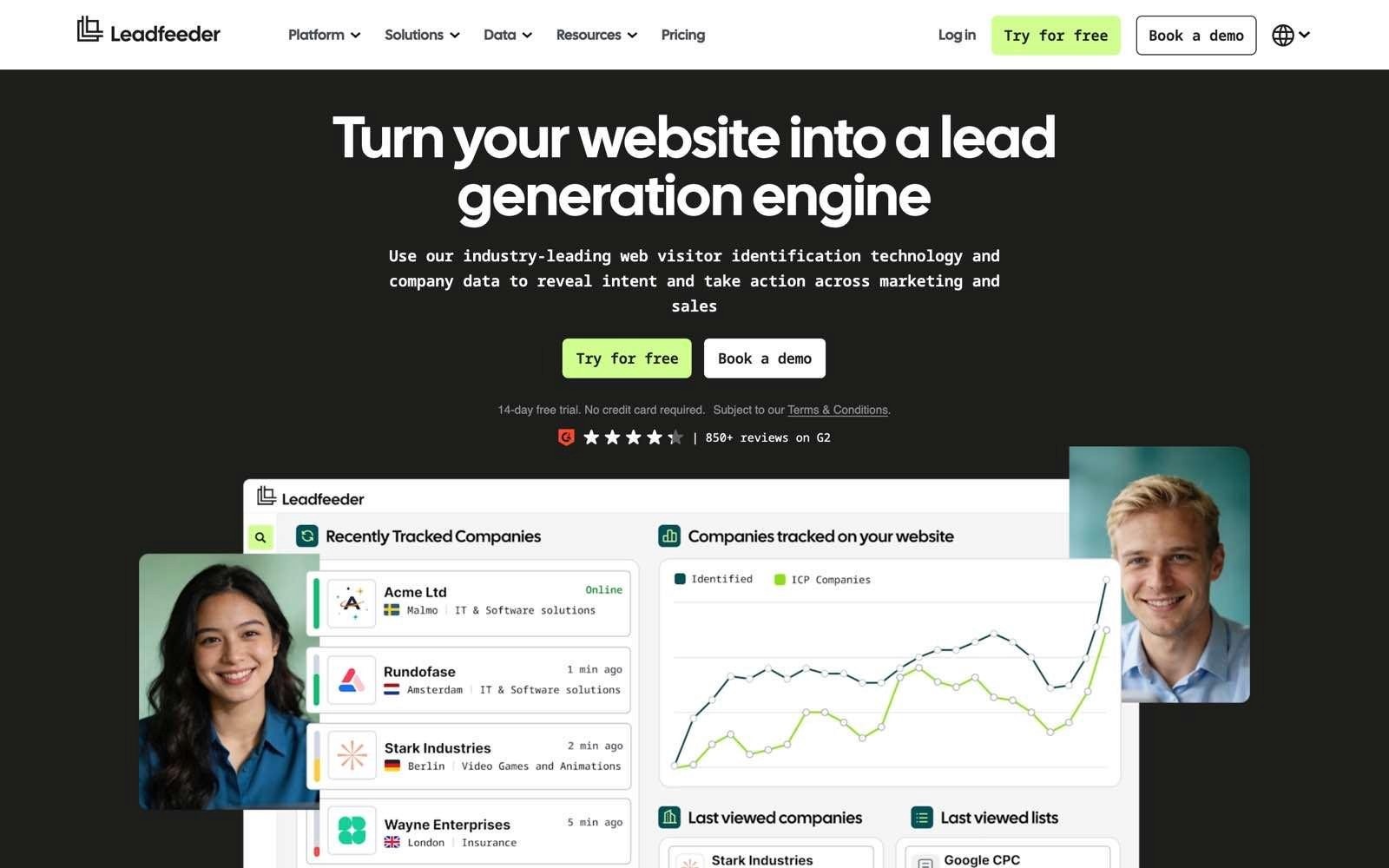
It reveals the companies visiting your site, sends real-time account alerts, pushes accounts into your CRM, and adds verified emails and intent filters on higher tiers.
For teams whose traffic is mostly European, the geography question that limits every person-level product in this review doesn't apply. Leadfeeder works at the account level throughout, its published positioning states it's compliant with Europe's privacy standards, and its parent entity is a German GmbH, which is the primary reason EU-heavy teams shortlist it over US-first vendors.
Ideal For
European B2B companies whose audience sits mostly inside the EU and UK
Teams that need company-level identification with EU data-handling expectations
Sales teams that want account alerts and CRM push at a sub-€100 entry price
Marketing teams running B2B display campaigns against identified accounts
Companies with unlimited-user needs, since seats aren't the pricing lever
Top Features
Company reveal with real-time alerts: Identified accounts trigger alerts as they visit, which keeps the signal actionable rather than retrospective.
CRM push and automations: Accounts flow into the CRM automatically, and higher tiers keep the CRM data updated without a manual refresh.
Intent signal filtering: The Activate tier filters identified accounts by intent, so the list narrows to accounts showing real research behavior.
Verified emails and phones: Contact details come with the account on Activate and above, which closes the gap between account-level identification and outreach.
Free Lite tier: €0 with no end date after the 14-day full-product trial, covering up to 100 identified companies a month with unlimited users and 7 days of visitor history.
Why They Stand Out?
Leadfeeder is one of the strongest choices for European B2B teams, and the reason is structural rather than a feature. A US-first vendor's person-level advantage disappears the moment your traffic is EU-based, at which point you're comparing account-level products on match quality, price, and data-handling posture. Leadfeeder competes well on all three for that audience.
Unlimited users across every tier is the other practical advantage. Because pricing scales on identified companies rather than seats, a whole sales team can work the same account feed without a per-user upgrade conversation, which matters more than it sounds when you're rolling the signal out beyond one champion.
Pros
Free Lite tier at €0 with unlimited users, and every paid plan opens with a 14-day trial with no card required
Paid entry at €79 a month billed annually, which is low for an established vendor
Unlimited users on every tier, so adoption isn't limited by seat cost
Verified emails and phones plus intent filtering on the €369 Activate tier
Published positioning on compliance with Europe's privacy standards, which matters for EU buyers
Cons
Company-level identification only, so no named contact comes from the visit itself
The headline €79 and €369 are the annual-commitment rates; billed monthly the same plans are €113 and €527, a 30% difference
The Lite tier caps at 100 identified companies a month and 7 days of history, which is a preview rather than a working deployment
CRM automations, AI prospect lists, and B2B display sit on the €369 tier and above
Scale at €599 a month is the one tier with no monthly option, which removes flexibility where dedicated CSM support arrives
Pricing
Five tiers, and every paid plan opens with the same 14-day full-product trial with no card required. Lite is €0 with no end date, covering unlimited users, 7 days of visitor history, and up to 100 identified companies a month.
Discover starts at €79 a month billed annually, or €113 billed monthly, and covers company reveal, real-time account alerts, CRM push, and automated outreach and retargeting.
Activate starts at €369 a month billed annually, or €527 billed monthly, and adds verified emails and phones, intent filtering, B2B display campaigns, CRM automations, and AI-built prospect lists. Scale starts at €599 a month, billed annually only, and adds unlimited data exports, automatic CRM updates, and a dedicated CSM. Enterprise covers custom volumes with a dedicated team.
Final Verdict
Leadfeeder is the recommendation for European B2B teams that need company-level identification with EU data expectations and unlimited seats, and its free tier makes the first evaluation costless.
The visit itself still resolves only to a company, and the verified contact details that Leadfeeder positions Activate around sit at €369 a month on an annual commitment, so budget for that tier rather than the headline price.
9. Lead Forensics
Overview
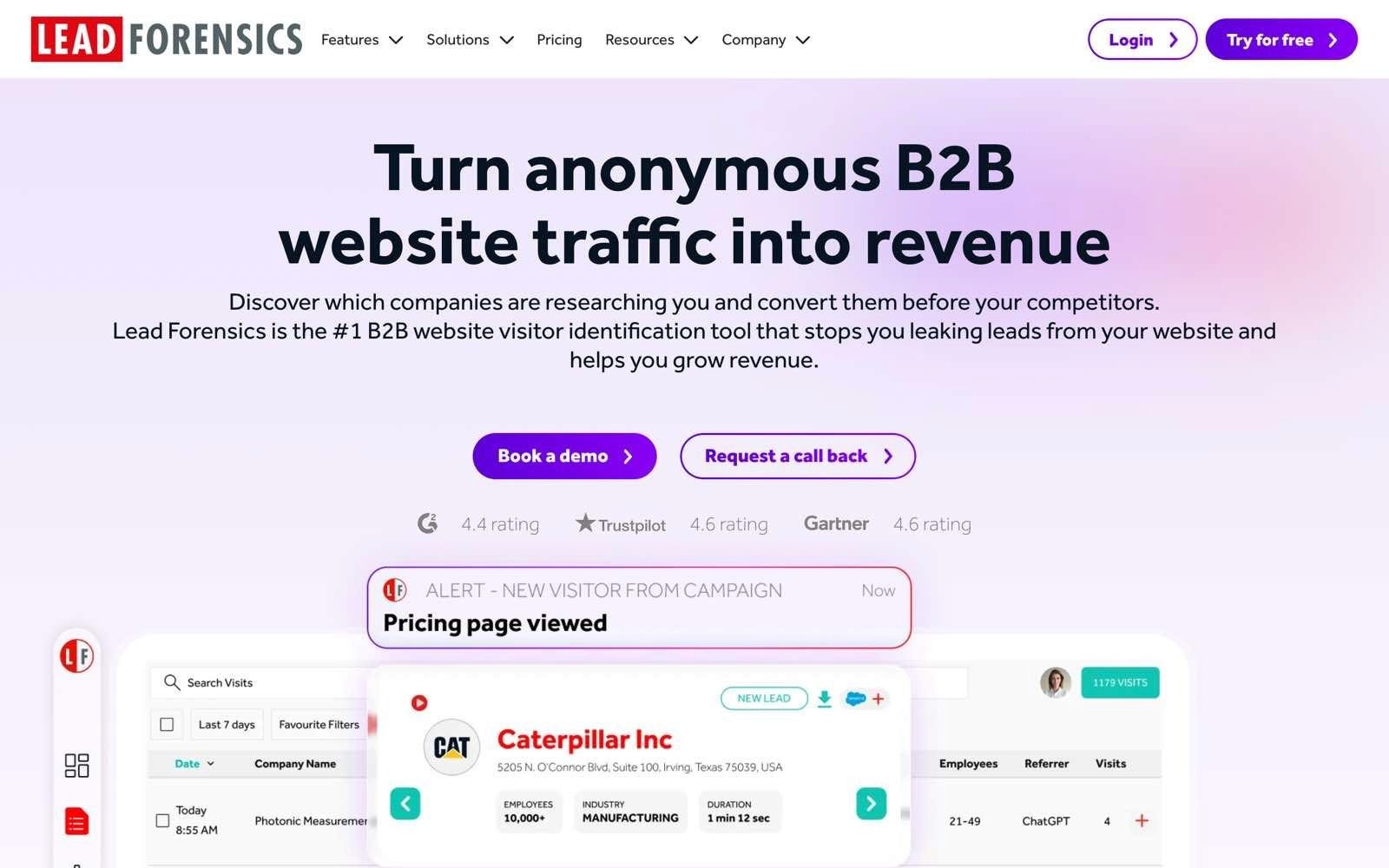
Lead Forensics is one of the longest-established company-level identification products, built on matching the IP addresses of businesses visiting a website to firmographic records. It identifies companies rather than individuals and provides full visitor firmographic insight alongside unlimited user access on every plan.
The product is aimed at organizations that want the account feed available to a whole revenue team rather than a single ops owner.
Its published positioning centers on unlimited users meaning the whole business gets value fast, and its pricing FAQ states the quote is based on how much traffic your site gets and how many new leads it uncovers, established during a free trial.
Ideal For
Mid-market and enterprise sales teams that want the account feed available to everyone
Organizations that prefer volume-based pricing to per-seat licensing
Companies with high traffic where seat-based tools become expensive
Teams that want firmographic depth on identified accounts rather than contact records
Buyers comfortable with a demo-led procurement process
Top Features
IP-to-company identification: Business IP addresses resolve to company records, which works globally at the account level.
Full visitor firmographic insight: Identified accounts arrive with firmographic detail attached, so scoring doesn't need a second data source.
Unlimited user access on all plans: The account feed can be shared across sales, marketing, and CS without a per-seat cost, and a dedicated customer success manager is listed alongside it.
Essentials and Automate tiers: Automate adds workflow capability on top of the identification feed for teams that want the signal to trigger actions.
Decision-maker contact data: Alongside the company record, the plan comparison lists decision-maker contact data, so an identified account arrives with people attached.
Why They Stand Out?
Lead Forensics is one of the strongest options for organizations that want breadth of access rather than depth of resolution.
Unlimited seats across every plan means the identified-account feed can reach an entire revenue team, and for a company where twenty people would otherwise need licenses, the total cost comparison shifts meaningfully.
Longevity is the second consideration, and in a category where three well-known products changed hands or were retired inside seven months, a vendor that has served a stated 10,000 growing businesses over many years is a lower-variance choice for a multi-year commitment.
Pros
Unlimited user access on every plan, so the whole revenue team can work the feed
Full firmographic detail attached to each identified company
Pricing scales on visitor volume rather than seats, which suits large teams
A free, no-obligation trial establishes real volume before any commitment
An established vendor with a long operating history in a category that's consolidating quickly
Cons
No published pricing at all, so evaluation requires a demo and a quote
The visit resolves to a company rather than a named visitor, so the decision-maker contacts it supplies come from the account record rather than from the session
Volume-based pricing means costs rise with traffic growth, which can penalize a successful content program
Two tiers only, so there's less granularity than the four and five-tier structures competitors publish
Procurement is demo-led rather than self-serve, which slows a quick evaluation
Pricing
Lead Forensics doesn't publish list prices. Pricing is calculated on your website visitors, with unlimited users included, and its pricing FAQ adds that the quote also reflects how many new leads it uncovers.
The figure is established during a free, no-obligation trial that follows a demo. Two tiers are named publicly, Essentials and Automate, and both require booking a demo for pricing.
Final Verdict
Lead Forensics suits mid-market and enterprise teams that want company-level identification shared across a large revenue org without per-seat costs, and the volume-based model can work out cheaper than seat licensing at scale.
It's a weaker fit for teams that need the individual visitor name rather than the account, for anyone who wants to compare list prices before a sales call, and for high-growth companies whose traffic increases faster than their budget.
10. 6sense
Overview
6sense is an account-based product built around predictive intent, and website identification is one input into a much larger model. It combines on-site behavior with third-party intent data, then applies predictive AI scoring to estimate which accounts are in-market before they identify themselves.
The scope is the point and the caveat. 6sense answers a broader question than any other tool in this review, covering off-site research, predictive stage modeling, advertising, and sales enablement through its Sales Copilot.
It's also the entry with the least published pricing, offering three Sales Intelligence configurations quoted on request.
Ideal For
Enterprise ABM programs with dedicated marketing and sales ops functions
Teams that already buy third-party intent data and want it modeled rather than listed
Organizations running account-based advertising alongside identification
Revenue teams that need predictive account scoring for territory and prioritization decisions
Companies with the internal capacity to operate a large account-based product
Top Features
Predictive AI account scoring: Models estimate which accounts are in-market, which extends beyond the accounts that have visited your site.
Off-site intent data: Research behavior across the wider web feeds the same account view as on-site activity.
Sales Copilot: A Chrome extension and AI writer put account and contact insights in front of reps where they work.
Advertising with published economics: Campaigns run from a $100 minimum budget over a 7-day minimum with a $1.00 minimum CPM bid, and 6sense publishes the fees that come off campaign spend rather than leaving them implicit.
Data credits for enrichment: Credits unlock and export emails, phone numbers, and enriched contact and company records.
Why They Stand Out?
6sense is one of the strongest choices for mature ABM programs, because it answers the question that pure identification tools can't. Site identification only ever shows you accounts that already found you, and predictive intent modeling points at accounts researching your category somewhere else entirely.
The advertising economics are unusually well documented for an enterprise product. 6sense publishes a $100 minimum campaign budget, a 7-day minimum duration, a $1.00 minimum CPM bid, and no obligation to commit a specific spend unless you request pre-paid options.
It also publishes what comes off the top, stating that variable data and service fees are deducted from campaign spend and typically fall within a range of 15% to 18%, and that its bid shading algorithm typically returns 5% to 15% in savings.
Pros
Predictive intent extends coverage beyond accounts that have already visited your site
Off-site and on-site intent modeled together in one account view
Advertising minimums, the 15% to 18% data and service fee range, and bid-shading savings are all published rather than quoted privately
Sales Copilot puts account insight into rep workflows rather than a separate dashboard
Three Sales Intelligence configurations let large organizations buy only the modules they need
Cons
No published subscription pricing, so budgeting requires a sales conversation
The product is scoped for enterprise ABM, so a small team will pay for capability it can't operate
Predictive scoring quality depends on clean CRM and account data going in
Data credits are a separate consumption lever on top of the subscription, which complicates forecasting
Site deanonymization is one component rather than the focus, so a team that only wants visitor identification will overbuy
Pricing
6sense doesn't publish subscription prices. Sales Intelligence is offered in three configurations, combining Sales Intelligence with data credits, predictive AI, or both, and all routes lead to a demo.
Advertising is priced separately and documented publicly, with a $100 minimum campaign budget, a minimum 7-day campaign duration, and a $1.00 minimum CPM bid. Variable data and service fees are deducted from campaign spend and typically fall in a 15% to 18% range.
Data credits within Sales Intelligence are used to unlock and export emails, phone numbers, and enriched contact and company records.
Final Verdict
6sense is the right choice for enterprise ABM teams that need predictive intent across the whole market rather than identification of the traffic they already have, and publishing its advertising fee ranges is a genuine advantage.
It's over-scoped and over-priced for a team whose actual requirement is knowing who visited the pricing page, and the quote-only model makes it hard to evaluate against the published pricing of everything else in this review.
How to Choose the Best Website Deanonymization Tools
The tools in this review resolve visits at different levels and cover different geographies, and they land the signal in different places. These seven factors decide which one fits, roughly in the order you should work through them.
1. Decide Between Account-Level and Person-Level Identification First
This choice narrows the list faster than anything else, because geography constrains it rather than budget. Person level visitor identification is limited to United States traffic at every vendor here that offers it, and each one publishes that limit.
RB2B states its Person-Level Identity is a US-only technology with a US-only database. Vector states it's geofenced to only operate in the United States.
Apollo states contact-level identification is currently available for US-based visitors. Warmly states its providers only resolve US traffic and don't match individual contacts inside the EU.
If your audience is mostly European, account level visitor identification is the whole category for you, and Factors, Leadfeeder, HubSpot, and Lead Forensics are the shortlist. If your audience is US-heavy, you get to choose, and person-level output is worth the premium if your reps will actually call the named contact.
2. Read the Coverage Band on the Plan You're Buying
Headline match rates and per-plan coverage figures often describe different things, and the gap can be large. RB2B's pricing page banner states "RB2B + DEMANDBASE = 70-80% RESOLUTION" for people and companies combined, while the plan table lower down the same page lists contact-level coverage at 15-20% on Starter and Pro and 35-45% on Pro+.
Factors' pricing page states Basic and above unmask over 75% of companies visiting your website, which is an account-level figure and not comparable to a person-level one.
Neither presentation is wrong, and both are published openly. The practical step is to compare figures at the same resolution level, on the specific plan you intend to buy, and to treat the trial as the real measurement. A trial on your own traffic tells you more than any published band.
Check the volume ceiling in the same breath, because a match rate is worthless above it. Factors publishes hard caps in its plan comparison, at 1,500 identified companies a month on Lite and 3,000 on Basic, so a site with heavy traffic can exhaust the allowance long before the 75% figure becomes relevant.
Warmly's tiers each start at 10,000 credits a month, Vector's Reveal tiers are sold in bands from 2,500 to 10,000 identified visitors, and RB2B charges 25c to 45c per resolution once you pass your plan's allowance.
3. Check Who Owns the Roadmap Before You Sign an Annual Contract
The independent middle of the inbound stack shrank considerably in 2026, and it happened fast enough that many roundups haven't caught up. Salesforce signed to acquire Qualified in December 2025 and, per its own quarterly filing, completed the deal in April 2026 at an acquisition-date fair value of $1.2 billion, consisting primarily of $1.1 billion in cash.
On March 5, 2026, Clari + Salesloft announced the gradual sunset of its Drift conversational marketing product and named 1mind as the exclusive successor. On June 15, 2026, Salesforce signed to acquire Fin, formerly Intercom, for approximately $3.6 billion. Fifteen days later, Warmly announced its agreement to be acquired by HubSpot.
The follow-up questions for a buyer are concrete. Ask where the product sits in the acquirer's plans, what the support and pricing commitments are past the current term, and what your exit looks like if the roadmap moves toward a CRM you don't use.
Warmly's announcement states that existing contracts, pricing, account teams, product experience, and integrations remain unchanged today, and that connecting its capabilities across HubSpot's product line is the ambition. Both halves of that are worth knowing before a two-year signature.
4. Confirm Where the Signal Lands and Who Sees It
A match that arrives in a vendor dashboard nobody opens is worth nothing, so trace the path from identification to the person who acts. The three destinations that matter are a Slack or Teams channel owned by a named rep, a CRM record that updates the existing account rather than creating a duplicate, and a sequencer that can enroll the contact without an export.
Check the integration list against the tools you already run, and check it at the tier you're buying. RB2B's Slack and Teams delivery is available at $79 a month, while its wider integration list including Clay, HubSpot, Salesforce, and Apollo arrives at $149.
Warmly includes Slack alerts and CRM sync at its entry tier. Apollo puts the identified contact in the same product as the sequence, which is the strongest version of this and the reason consolidation appeals.
5. Build the Routing Logic That Runs After the Match
Turning identification on takes an afternoon. The routing that follows it has to be built, which is where most deployments stall a month in. The branch logic below is the play we implement for clients, and it starts with a CRM lookup rather than an alert.
Not in the CRM, tier one account: Create the contact and start outreach that week, because a pricing-page visit from a target account is the clearest buying signal you'll get for free.
Not in the CRM, not tier one: Keep the record for job-change tracking and demand mapping instead of discarding it, since the same person at a different company in eight months is a warm account.
In the CRM with an open opportunity: Notify the owning rep only, because a live deal researching your site is a call today rather than a new lead.
In the CRM as a customer: Route to the account manager or CS rep, since a customer on your pricing page is an expansion or a churn signal depending on which page.
In the CRM as an uncontacted lead: Put them back into a sequence, because the visit is evidence that the timing changed since the last attempt.
Getting there needs your ICP defined tightly enough to sort accounts automatically, which is a prerequisite rather than a step.
Our ideal customer profile guide covers the firmographic and signal criteria that make tier-one qualification something a workflow can decide.
From there, the outreach half of the play follows the same principles as any B2B outbound strategy, with a live intent signal replacing the list.
6. Treat Consent and Configuration as Part of the Build
Website deanonymization can be operated compliantly, and it isn't automatically compliant because a vendor says so.
What actually determines your position is geography, the tracking technology, consent, lawful basis, transparency, downstream marketing, retention, and your own configuration, and eight variables mean vendor assurances only cover the ones they control.
Two points do most of the work in practice. A privacy-policy disclosure is not a substitute for consent where consent is legally required, and the script has to be genuinely prevented from firing until the appropriate consent is received rather than merely disclosed somewhere.
Vendors document how to handle this to varying degrees. Warmly's help center states that customers can place both the JavaScript and the cookie behind a cookie banner, or place just the cookie behind it while the JavaScript fires.
RB2B's help center states that it does not enforce consent on your behalf and that you're responsible for ensuring your website complies with applicable privacy and consent regulations, including using consent management tools where required. Get your own counsel to sign off on the configuration you deploy.
7. Price the Build Alongside the Subscription
The subscription is rarely the largest number. A $79 a month tool that needs 30 hours of internal ops work to route properly costs more in the first quarter than a $10,000 a year tool with CRM sync included, and neither figure appears on a pricing page.
Add up the license, the credits or resolutions you'll consume at your traffic volume, the enrichment calls the routing logic will make, and the internal or external time to build and maintain it.
Enrichment cost is worth engineering deliberately, since one client of ours processed 18,000 leads for roughly $38 by routing classification through OpenAI rather than through Clay credits.
If you're comparing the data layer underneath these tools, our roundup of the best data enrichment tools covers what each provider actually returns.
Everything You Need to Know About Website Deanonymization Tools
Company | Pros | Cons | Ease of Use | Integrations | Support | Affordability | Resolution |
The GTM Engineering Company | Tool-agnostic vendor selection; routing logic built in your CRM; SOPs and Looms on every workflow | Retainer rather than a subscription; out of scope pre-PMF; limited monthly slots | ⭐⭐⭐⭐⭐ | ⭐⭐⭐⭐⭐ | ⭐⭐⭐⭐⭐ | ⭐⭐⭐ | Both |
Warmly | Person-level plus same-session AI chat; Slack and CRM sync at entry tier; published pricing | $10,000/yr entry; engagement features on higher tiers; US-only person matching | ⭐⭐⭐⭐ | ⭐⭐⭐⭐⭐ | ⭐⭐⭐⭐ | ⭐⭐⭐ | Person + account |
RB2B | Free tier and $79/mo entry; person-level output at a low price; minutes to set up | Self-serve by design; emails need the $149 tier; US-only person-level | ⭐⭐⭐⭐⭐ | ⭐⭐⭐⭐ | ⭐⭐⭐ | ⭐⭐⭐⭐⭐ | Person (US) + account |
Vector | Identifies ad clickers, not only visitors; $399/mo month-to-month entry; native CRM sync | US-geofenced identity graph; Target tier from $3,000/mo; marketing-first feature set | ⭐⭐⭐⭐ | ⭐⭐⭐⭐ | ⭐⭐⭐⭐ | ⭐⭐⭐ | Person (US) + account |
Factors.ai | Waterfall enrichment across providers; works the same globally; attribution built in | No person-level output; analytics gated to $20K/yr and up; needs a marketing owner | ⭐⭐⭐⭐ | ⭐⭐⭐⭐ | ⭐⭐⭐⭐ | ⭐⭐⭐⭐ | Account |
Apollo | Company-level ID on the free plan; one bill for ID, enrichment, and sequences; 65+ enrichment fields | Contact-level needs the Inbound add-on; US-only contact resolution; credit-based costs | ⭐⭐⭐⭐ | ⭐⭐⭐⭐⭐ | ⭐⭐⭐ | ⭐⭐⭐⭐ | Person (US) + account |
HubSpot Breeze Intelligence | Native to the CRM; global company-level intent; credits already included in your plan | Company-level only; HubSpot-only; credit use scales with volume | ⭐⭐⭐⭐⭐ | ⭐⭐⭐⭐⭐ | ⭐⭐⭐⭐ | ⭐⭐⭐⭐ | Account |
Leadfeeder (formerly Dealfront) | Free Lite tier; €79/mo paid entry; unlimited users on every tier | Company-level only; annual billing on list prices; key features on the €369 tier | ⭐⭐⭐⭐ | ⭐⭐⭐⭐ | ⭐⭐⭐⭐ | ⭐⭐⭐⭐ | Account |
Lead Forensics | Unlimited seats on all plans; full firmographic detail; volume-based pricing | No published pricing; company-level only; costs rise with traffic | ⭐⭐⭐ | ⭐⭐⭐ | ⭐⭐⭐⭐ | ⭐⭐⭐ | Account |
6sense | Predictive intent beyond your own traffic; off-site and on-site in one view; published ad fee ranges | No published subscription pricing; enterprise scope; credits on top of subscription | ⭐⭐⭐ | ⭐⭐⭐⭐⭐ | ⭐⭐⭐⭐ | ⭐⭐⭐ | Account + predictive |
Ratings reflect each vendor's published setup time, integration list, documented support access, and list pricing as of September 2026, not user survey scores.
Build Your Visitor Identification Layer with GTM Engineering
Every week that identified visitors sit unread in a vendor dashboard, target accounts open your pricing page and leave without a rep knowing. The tool choice from this review is the small decision.
The build that filters those visitors against your ICP and puts them in front of the person who can act is what turns the signal into pipeline.
We install and test the identification tool that matches your traffic and deal size, score identified accounts in Clay against your ICP, and wire the branch logic that checks the CRM before anyone gets an alert. WebAI recovered 1 in 5 inbound leads as qualified ICP after we shipped its de-anonymization and visitor-tracking build.
Every workflow ships with an SOP and a Loom walkthrough, so your team owns and extends the system after the engagement ends, and the CRM audit is included in the retainer rather than quoted separately.
Retainers start at $4K a month on a 3-month term, and the first 30 days produce a documented punch list, a working golden enrichment table, and at least one operational signal flowing into your CRM.
Book a 30-minute call and we'll audit what your current visitor data is doing and tell you what's missing.
FAQs About Website Deanonymization Tools
What is the best website deanonymization tool in 2026?
The best website deanonymization tool in 2026 depends on whether you need person-level or account-level resolution, and Warmly is the strongest person-level product while Factors is the strongest account-level one. Warmly starts at $10,000 a year and pairs named-contact identification with same-session AI chat. Factors starts at $199 a month for Lite and uses waterfall enrichment to unmask over 75% of visiting companies on its Basic tier and above. RB2B is the cheapest way to test the category at $79 a month, and it publishes contact-level coverage bands of 15-20% up to 35-45%. Person-level identification is limited to US traffic at all three.
What should I consider when choosing a deanonymization tool?
When choosing a deanonymization tool, start with resolution level and geography, because person-level identification is restricted to United States traffic at RB2B, Vector, Apollo, and Warmly. Next, compare coverage bands at the same resolution level on the specific plan you intend to buy rather than comparing a person-level figure to an account-level one. Then confirm the signal can reach your CRM and your sequencer at that tier, since RB2B's wider integration list starts at $149 a month rather than $79. Finally, budget the routing build alongside the license, because a $79 tool that needs 30 hours of ops work costs more in quarter one than a $10,000 a year tool with CRM sync included.
How does The GTM Engineering Company differ from similar alternatives?
The GTM Engineering Company builds the filtering and routing layer that makes a deanonymization tool produce pipeline, which is a different job from selling the identification data. Every tool in this review delivers a name, and the value comes from the branch logic that checks your CRM, qualifies the account against your ICP, and alerts the specific person who should respond. We build that inside your own CRM on a 3 or 6-month retainer at $4K to $6K a month, tool-agnostic, with an SOP and a Loom on every workflow so your team owns it afterward. By day 30 you have a documented punch list, a working enrichment table, and at least one signal flowing into the CRM.
How do I get started with The GTM Engineering Company?
You get started with a 30-minute call, and the first 30 days of every engagement are an audit plus a first-build sprint. By day 30 you should have a documented punch list, a working golden enrichment table, and at least one operational signal flowing into your CRM. The CRM audit is included in the retainer rather than scoped as a separate SOW, so there's no separate diagnostic contract to sign first. Retainers run 3 or 6 months at $4K a month for a single workstream or $6K a month for parallel workstreams.
How easy is it to switch to The GTM Engineering Company?
Switching is straightforward because we work inside your existing stack rather than moving you onto ours. If you already run RB2B, Warmly, Apollo, or Factors, we keep the tool and rebuild the layer above it, so nothing gets ripped out and re-procured. The weekly 2-hour working session means your team watches every table and workflow get built, which is also how the handover happens. If you inherited an undocumented contractor build, we'll audit what's running and tell you honestly whether it's worth keeping.
Is website deanonymization legal and GDPR compliant?
Website deanonymization can be operated compliantly, and no vendor's assurance makes your specific setup compliant on its own. Your position depends on geography, the tracking technology, consent, lawful basis, transparency, downstream marketing, retention, and your own configuration. A privacy-policy disclosure is not a substitute for consent where consent is legally required, and the script has to be genuinely blocked from firing until consent is received. RB2B states that person-level identification is never performed outside the United States and that it does not enforce consent on your behalf, and Warmly states that customers can place the cookie or the whole JavaScript behind a cookie banner. Get your own counsel to review the configuration you actually deploy.
How do I identify anonymous website visitors without a form?
You identify anonymous website visitors by installing a vendor script that reads each session's IP address or device fingerprint and matches it against an identity graph, which returns a company or a named person without any form submission. Account-level matching works globally because a business IP address maps to a company record, and it's the approach Factors, Leadfeeder, HubSpot, and Lead Forensics use. Person-level matching returns an individual and is scoped to US traffic at every vendor that offers it, using hashed email and device data rather than IP alone. The identified record then arrives in a dashboard, a Slack channel, your CRM, or a webhook, depending on the tier you buy.
About the Author
Jorge Macías is the founder of The GTM Engineering Company, where he works as an embedded fractional GTM engineer building CRM, enrichment, scoring, and signal-based outbound infrastructure inside client stacks. He is a Y Combinator S18 alumnus, a member of the Clay Expert Program, and an instructor across two cohorts of GTM Engineer School, and he has shipped GTM systems for UiPath, Spara, Fluint, Slate, WebAI, and NodeSource. Connect with him on LinkedIn.